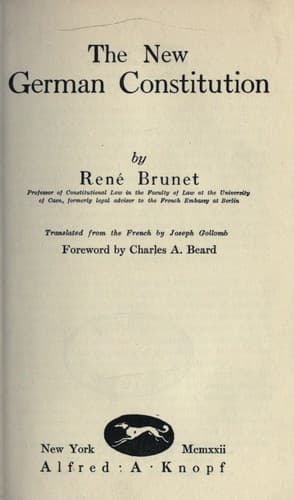
Germany -- Politics and government -- 1918-1933; Germany. Verfassung (1919)
This last will be studied in the section of this book devoted to the
Economic Constitution. In the present chapter we shall study the other
organs, and shall inquire in what measure they are capable of insuring
and do insure in fact to Germany the parliamentary government which it
has chosen.
SECTION I
THE REICHSTAG
The Reichstag already existed under the régime of 1871. But its
powers have become much more extensive, for it is now the principal
representative of the people, from whom sovereignty is derived. It is
the principal holder of popular sovereignty. In conformance with the
principles of parliamentary government, it enacts laws and controls
the Cabinet. The regulations that determine its composition and which
specify its powers should, therefore, be such as to permit it to fulfil
completely its double rôle.
1.--THE PRIVILEGES AND GUARANTEES ACCORDED TO THE REICHSTAG.
The Reichstag, charged with the expression of the will of the sovereign
people, must be able to manifest this will freely. Charged with the
control of the Cabinet it must be protected against all possible
counterventions of the latter. To this end the Constitution contains a
number of provisions which give to the Reichstag as a body, as well as to
its members as individuals, a group of guarantees designed to insure for
them complete independence of the Cabinet.
* * * * *
(1) The Reichstag considered as a whole possesses a certain number of
privileges and guarantees, much more numerous than those which were
allowed the former Reichstag and analogous to those which in general
the parliaments in other free countries possess. To this end the German
Constitution contains several special features.
Public-domain text, read in full here on John Shaqi.
Reviews
Reviews
No reviews yet
Be the first to share your thoughts on this work.
Elsewhere in the archive
Join the Discussion
Join the discussion
Sign in to leave a comment or review.
Sign InorCreate an account