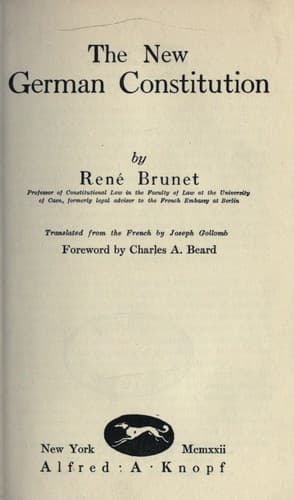
Germany -- Politics and government -- 1918-1933; Germany. Verfassung (1919)
For the initiative, the procedure is naturally more complicated, for it
consists of two phases. One part of the people takes the initiative and
collects support for it. If this support attains the numbers prescribed
by the Constitution, a referendum is called. The initiative, therefore,
is always followed by a referendum, unless in the interim the authors of
the initiative have been satisfied otherwise.
The difficulty is to organize effectively the first phase of this
procedure, to launch the initiative properly so-called, in a country
comprising on the average thirty million electors who vote. In the Swiss
cantons, and in the United States of America, the initiative comes into
being by the gathering of signatures to a petition. In Switzerland such
signatures of electors often require authentification; but this leads
to considerable difficulty, for, frequently the electors have their
names signed by others whom they delegate to do so. In certain of the
United States the conditions for the exercise of the right of initiative
are variable. Often it is sufficient that the individuals who gather
the signatures to such petitions give assurance that the signers are
qualified electors.
In Germany it is believed that such a system could not be accepted and
a procedure has been considered in which the electors would inscribe
themselves on lists placed at their disposal by district authorities. In
addition the formality of inscription on these lists would be preceded by
an examination whose purpose would be to see if the conditions provided
by the Constitution for the inauguration of a popular initiative have
been complied with. This provision has for its purpose the elimination
of initiatives doomed obviously to failure. This would permit the
public authorities, once the principle of the initiative is accepted,
to announce such a possibility officially in order to give the people a
chance to take a position on the matter.
A demand that an initiative be admitted must be made by at least
five thousand electors. When the proposal for the inauguration of an
initiative has been admitted, all the electors can vote on it within a
period, which usually is about thirty days. This voting is done under the
auspices of the district authorities, to whom the task of gathering and
counting the signatures is thus confided as one of their official duties.
If the signatures thus gathered are sufficient in number, the referendum,
if it is decided upon, proceeds according to the provisions indicated
above and which are analogous to the electoral procedure.
CHAPTER IV
PARLIAMENTARY GOVERNMENT
A democracy, above all one comprising seventy million inhabitants, no
matter to what great extent it makes use of direct government, cannot
nevertheless govern itself that way. It must furnish itself with
representatives charged with the direction of public affairs. Democracy
presupposes by definition a representative government.
Public-domain text, read in full here on John Shaqi.
Reviews
Reviews
No reviews yet
Be the first to share your thoughts on this work.
Elsewhere in the archive
Join the Discussion
Join the discussion
Sign in to leave a comment or review.
Sign InorCreate an account