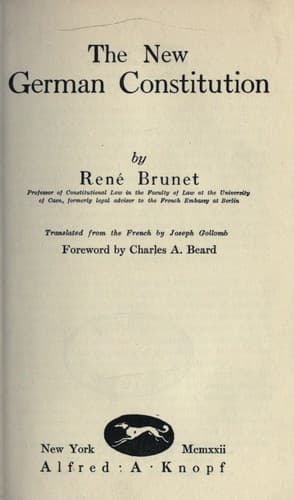
Germany -- Politics and government -- 1918-1933; Germany. Verfassung (1919)
It is known that the right of political assemblies to pass on the
eligibility of their members and the regularity of their elections
constitutes one of their traditional prerogatives, one to which they
have most strongly adhered. For they have seen in it a weapon against
executive power to be used in cases where the latter is tempted to abuse
its authority and exercise pressure on elections. Also most of the
democratic countries confer upon their Chambers the right to investigate
the election of their members and to decide in sovereign fashion on the
validity of these elections. Such is the rule particularly in France;
such was the rule in Germany up to 1919. But the new Constitution
abandons this tradition in the sense that instead of leaving election
disputes to the Reichstag itself, it entrusts them to a special
tribunal working alongside of the Reichstag: the Electoral Commission
(Wahlprüfungsgericht). This device, however, was not inspired by any
desire to limit the rights of the Reichstag. It was dictated by political
considerations. The former Reichstag, when it verified the election of
its members, instead of being inspired solely by legal motives often
let itself be guided by political considerations. The verification of
elections is in itself an act of adjudication, and a political assembly
is ill-prepared to fulfil such a function. That is why the English
Parliament has already entrusted the function of judging of elections of
its members to a separate tribunal. Without going as far as that, the
new German Constitution refers contestants to a mixed tribunal, in which
there are both members of the Reichstag, and, in order to insure the
impartial applications of legal provisions, judges by profession.
The Electoral Commission includes members of the Reichstag elected to
it by the whole legislature, as well as members of the Administrative
Tribunal; until the creation of this body these consist of members of
the National Judicial Court or Reichsgericht. These are nominated by the
President of the Reich on the motion of the President of the Commission.
In order to become operative the Electoral Commission must be made up as
follows: five judges, of whom three must be members of the Reichstag, and
two magistrates. The procedure is presided over by a commissioner named
by the President of the Reich. This commissioner is particularly charged
with investigation. It is hoped in Germany that in consequence of the
introduction of proportional representation, election contests will be
less frequent than formerly and that adjudications of elections by this
Commission will have less importance for the parties than in the past.
* * * * *
Public-domain text, read in full here on John Shaqi.
Reviews
Reviews
No reviews yet
Be the first to share your thoughts on this work.
Elsewhere in the archive
Join the Discussion
Join the discussion
Sign in to leave a comment or review.
Sign InorCreate an account