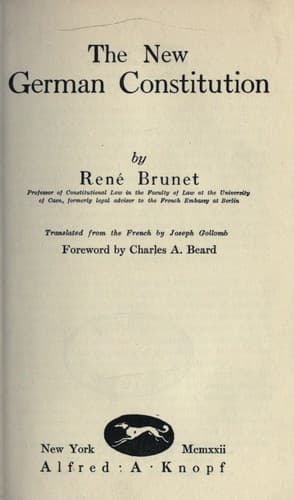
Germany -- Politics and government -- 1918-1933; Germany. Verfassung (1919)
Once elected and the elections verified, can the Reichstag freely meet
and continue just as it pleases? In other words, can it be permanent,
that is to say, has it the right itself to fix the date and the duration
of its sessions? A double danger is here possible. To create a permanent
assembly, would it not give to parliament a dangerous preponderance? But
to give to the executive power unlimited right to call, adjourn, and
prorogue parliament, would it not be to give a prerogative unacceptable
to a democratic country and dangerous to the maintenance of its
institutions?
Under the old régime, the Reichstag could not meet or commence its work
without having been convoked by the Emperor and expressly opened by him.
However, the Constitution provided, that the Reichstag must be convoked
at least once every year. But the Emperor had the right to prorogue the
assembly; and the latter had not the right to sit and continue its work
against the wish of the Emperor. The Emperor’s right in this respect had
but one limitation: the prorogation of the Reichstag could not extend
beyond thirty days without the consent of the Assembly, and it could not
be renewed during the same session. On the other hand, the Reichstag
could not conclude its sessions without the consent of the Emperor. It
could only interrupt its meetings.
The new Constitution gives the Reichstag the right to _convoke itself
and to meet of its own accord_. It is the Reichstag which decides as to
when it is to meet and how long its session is to continue. It is neither
convoked nor adjourned by the President of the Reich. According to the
Constitution of Weimar the Reichstag meets for the first time no later
than the thirtieth day after elections. In addition it is required to
meet every year on the first Wednesday in November at the seat of the
government. The Reichstag also decides for itself the conclusion of its
sessions and the day of its re-assembling. However, the President is
bound in two cases to convoke the Reichstag at a time prior to the annual
date fixed by the Constitution, or to the date fixed by the Reichstag
for its re-assembling. Such situations are (a) when the President of the
Reich, (b) when at least a third of the Members of the Reichstag, demand
it.
* * * * *
Public-domain text, read in full here on John Shaqi.
Reviews
Reviews
No reviews yet
Be the first to share your thoughts on this work.
Elsewhere in the archive
Join the Discussion
Join the discussion
Sign in to leave a comment or review.
Sign InorCreate an account