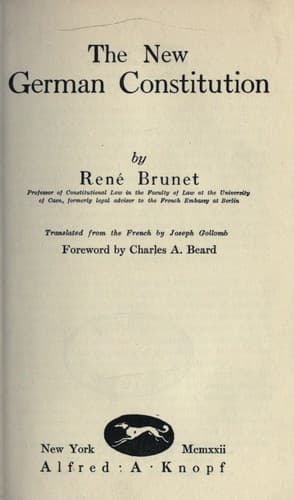
Germany -- Politics and government -- 1918-1933; Germany. Verfassung (1919)
Independent as it is of the Cabinet, the Reichstag must be assured the
power freely to deliberate without fear of riots and insurrections. Most
governments have no special legislation in regard to this. They leave to
the assembly, to which a special guard is assigned, the right to protect
itself. Events, however, have demonstrated that in Berlin revolutionaries
either of the extreme Left or of the extreme Right become, when they so
desire, “masters of the street.” More efficacious measures had to be
provided than prevail elsewhere. Accordingly a law was passed by the
National Assembly, May 8, 1920, “for the protection of the Palace of the
Reichstag and of the Landtag (State Assembly).”[34] This law draws about
these palaces a perimeter of protection, within the limits of which no
armed troops may penetrate, and it also provides different measures to
make these palaces an adequate shelter against any _coup de main_ such as
may come at any time from revolutionists.
* * * * *
2. The Members of the Reichstag as individuals enjoy, like the Reichstag
as a whole, privileges and guarantees such as are necessary to insure
their independence. The situation accorded them in this respect is very
analogous to that which other democratic countries assure the members
of their popular legislatures. They receive compensation.[35] They are
“irresponsible and inviolable.”
2.--THE RULES OF THE REICHSTAG.
Protected against the Cabinet, against insurrections, and against
individuals who have designs on their independence, the deputies of the
Reichstag can and must organize themselves in such a way as to assure
for their labours maximum efficiency. It is imperative that the majority
shall be able to impose its will without thereby sacrificing the rights
of the minority. To this effect Article 26 provides, “The National
Assembly chooses its President, Vice-President, and its Secretaries. It
regulates its own procedure.”
The National Assembly adopted the procedure of the old Reichstag and the
new Reichstag seems to have continued it also.
Meanwhile a change of considerable importance has been adopted by the
National Assembly. Theretofore the members of the Reichstag were divided
by lot into bureaus, and these elected the committees. There are no
longer any bureaus; and the essential machinery on which the functioning
of the Assembly depends is the group or fraction, each of which consists
of all the members of the Reichstag belonging to the same party.
Public-domain text, read in full here on John Shaqi.
Reviews
Reviews
No reviews yet
Be the first to share your thoughts on this work.
Elsewhere in the archive
Join the Discussion
Join the discussion
Sign in to leave a comment or review.
Sign InorCreate an account