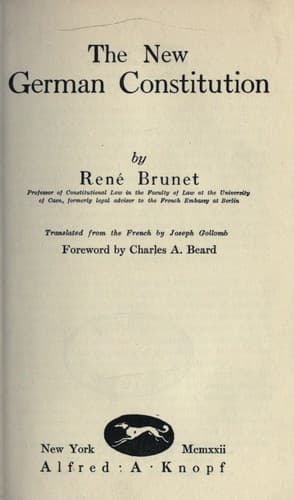
Germany -- Politics and government -- 1918-1933; Germany. Verfassung (1919)
Thus, therefore, Prussia elected a majority in the Reichstag, and if
by some extraordinary chance the latter voted against the desire of
Prussia the decree could be nullified by the Prussian representative
in the Bundesrath. The King of Prussia was Emperor. He nominated the
Chancellor, chief of all the administrative machinery of the state. The
King of Prussia was master of the government of the Empire. Germany was a
veritable Prussia enlarged.
We can now distinguish the essential traits that characterized
constitutional Germany on the eve of the war. There was in Germany, under
the infinite complexity of written provisions, behind a deliberately
effected juxtaposition of the most modern formula by the side of some of
the most archaic, a living reality. It was a despotic organization that
placed full power in the hands of a feudal monarch. It was, to put it in
the words of President Wilson, the largest enterprise of domination that
the world has ever known.
* * * * *
Such a system and that which made it such an anachronism could not
survive the test of war and still less that of defeat.
Already during the war several demands for reforms made themselves
felt. In proportion as the war was prolonged and the heavier became the
burdens that weighed on the people together with the sacrifices that
were imposed upon them, there developed a pressure on the part of the
people for recognition, for compensation, for the right to participate
in a more effective fashion in the conduct of public affairs. The
Reichstag appointed a commission to investigate to what extent it was
possible to modify the Constitution of the Reich in conformity with
the desires of the people. On his part the Emperor in a message on
April 7, 1917, declared that it was the duty of the Chancellor to
satisfy the exigencies of new times with every means appropriate; and
to reconstruct the constitutional edifice in such a way as to insure a
free and spontaneous collaboration of all the elements of the nation. The
Chancellor seemed to be in accord with the Emperor on the necessity and
urgency of a “new orientation.”
On the 15th of May, 1917, Bethmann-Hollweg spoke of realizing a programme
of “trusting collaboration of the Emperor and the nation.” On July 19,
1917, Michaelis foreshadowed the establishment of a close contact between
a government and parliament, the creation of a bond of mutual confidence
between the government of the Empire and the Reichstag, in the sense that
the management of various affairs should be entrusted to men who, aside
from their professional abilities, would enjoy the full confidence of the
great parties in the popular branch of the government.
Public-domain text, read in full here on John Shaqi.
Reviews
Reviews
No reviews yet
Be the first to share your thoughts on this work.
Join the Discussion
Join the discussion
Sign in to leave a comment or review.
Sign InorCreate an account