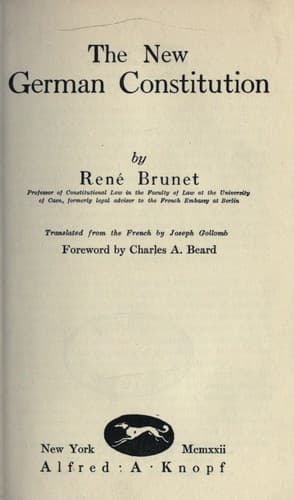
Germany -- Politics and government -- 1918-1933; Germany. Verfassung (1919)
They were nothing but vague words; and this “parliamentarization” of
the government of the Reich did not commence to show itself until
the pressure of defeat came, such as was felt in the summer of 1918.
The adoption of a parliamentary régime then seemed the sole means of
obtaining from the masses the sacrifices which were still expected of
them both on the firing line and in the interior.
The true reforms commenced with the letter which the Emperor wrote
on September 30, 1918, to the departing Chancellor von Hertling, and
which was a real message to the German people and to the Reichstag. “I
desire,” said the Emperor, “that the German people shall collaborate more
effectively than in the past in the determination of the destiny of our
Fatherland. It is my wish therefore that men invested with the confidence
of the people shall participate in a large measure in the rights and
duties of the government.” Legally it was only an expression of the
hitherto recognized imperial will. But from a political point of view
this message constituted the recognition of a new system of government,
in virtue of which the centre of gravity of political institutions
passed from the organs of the government, the Bundesrath and the Emperor,
to the popular assembly, the Reichstag.
The spirit in which the new reforms were to be carried out and the
importance which they were to assume were made clearer several days
later when, on October 5, 1918, Chancellor Maximilian of Baden in a
programme speech addressed in the Reichstag said, “It is in the essence
of the system of the government which we are now instituting that I now
state clearly and without reservation the principles by which I shall
seek to fulfil my heavy responsibilities. These principles were accepted
before I assumed my duties as Chancellor in an agreement reached between
confederated governments and the chiefs of the parties of the majority
of this Chamber.… It is only when the people take an active part to the
largest measure in the determination of the destiny of the nation; and
when the sense of responsibility is also shared by the majority of the
political chiefs freely elected, that a statesman can accept direction of
the helm with confidence and himself participate in this responsibility.
Otherwise the shoulders of one man will be too feeble to support the
immense responsibility that now confronts our government. I am convinced
that the manner in which the directing government has been formed to-day
with the collaboration of the Reichstag is not temporary in its nature
and that in times of peace hereafter no government can be formed that has
not the support of the Reichstag, that does not lean on the Reichstag,
and that does not take from the Reichstag its principal chiefs.”
As a consequence two laws were passed which carried the date of October
28, 1918. They were designed to meet the three most important exigencies
of the hour:
Public-domain text, read in full here on John Shaqi.
Reviews
Reviews
No reviews yet
Be the first to share your thoughts on this work.
Join the Discussion
Join the discussion
Sign in to leave a comment or review.
Sign InorCreate an account