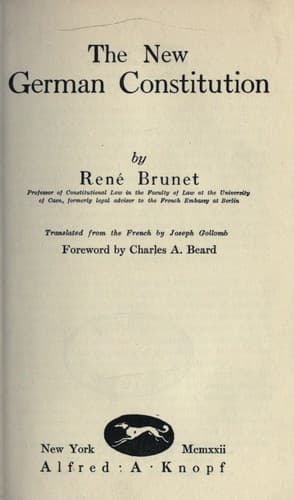
Germany -- Politics and government -- 1918-1933; Germany. Verfassung (1919)
The President is elected for seven years and is eligible for re-election.
The choice for so long a term and the possibility of re-election
corresponded closely to the prevailing idea according to which the
President should constitute a fixed and permanent point in the
constitutional mechanism. “Granting,” said Preuss, “that the institutions
set up by our Constitution should be as profoundly as possible stamped
with democratic character, it is best, for the solidity of the whole
edifice, that there should be in some part of it a durable and firm
framework.” The Social Democrats observed that the longer the term of
the President’s powers the more difficult it would be to effect a change
in the person, and consequently the greater was the danger of seeing a
life President installed. They proposed to fix five years as the term for
which the President could remain in power and to make re-election more
than once impossible. But this proposal was rejected.
* * * * *
Having fixed the term of the presidential power the Constitution had
to provide for the situation in which a President ceased to function
before the normal expiration of his powers or found himself prevented
from exercising them. It was not desired, as in the United States,
to institute a Vice-President who, as permanent representative and
possible successor of the President, would have the status, in the words
of Preuss, of a “republican crown-prince.” The provisions which were
thereupon adopted are much more supple.
In case the President ceases his functions before their normal
expiration, that is to say, in case of death, resignation, or
impeachment, a new election is immediately held.
In case he is prevented from filling his duties, there must be made a
distinction according to whether this inability seems apparently of
short or long duration. In the first case, that is, in case of slight
illness or because of a short voyage abroad, or during the first days
of a disability which seems likely to be prolonged, or in the interval
between the death of a President and the election of his successor,
the place of the President is filled by the Chancellor. In the second
case, that is, in case of serious illness or insanity, or when a motion
has been passed by the Reichstag to impeach the President, or there is
inaugurated a penal prosecution of the President before the National
Judicial Court, the Constitution decides that an ordinary law shall
determine expressly by whom his place shall be filled. This law may
according to circumstances either install a temporary Vice-President, or
confer temporarily the functions of the President on the Chancellor until
the President is able to resume office, or finishes his term.
3.--THE POWERS OF THE PRESIDENT.
Public-domain text, read in full here on John Shaqi.
Reviews
Reviews
No reviews yet
Be the first to share your thoughts on this work.
Elsewhere in the archive
Join the Discussion
Join the discussion
Sign in to leave a comment or review.
Sign InorCreate an account