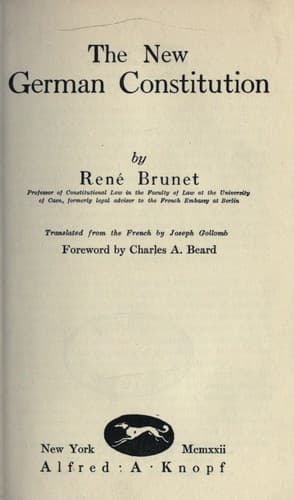
Germany -- Politics and government -- 1918-1933; Germany. Verfassung (1919)
(3) The President is finally _civilly_ responsible for any acts of damage
he may commit. Although he is not really a civil servant, in the actual
sense of the word, he is on this point subject to the same regulations
as the civil servants of the Reich. (The law on the responsibilities of
civil servants, March 22, 1910.)
SECTION III
THE CABINET OF THE REICH
The Cabinet in a parliamentary government constitutes a bond of union
between the parliament and the chief of state. In Germany it must play
a still more important rôle, since both the Reichstag and the President
are directly elected by the people and have theoretically the same equal
powers. It is therefore indispensable that an organism of co-operation
and equilibrium exist between them.
But this mechanism is extremely delicate. The rôle of the Ministry,
always very complex, depends above all on the traditions and the
circumstances of the men in question. What relations should subsist
between the President and the Prime Minister; between the Prime Minister
and the other members of the Cabinet; and in what measure should one be
subordinated to the others? What is the exact position of the Cabinet
in regard to the Chamber? Is it its guide, or must it be limited to the
execution of the Chamber’s decisions? These are questions of degree that
require or may require different solutions in each country for each
Ministry.
It is difficult, if not impossible, to decide on these in advance in a
complete and detailed manner. In England there is no written provision on
the manner in which the mechanism of the Cabinet must function. In France
there are a few vague and insufficient provisions in the Constitution.
But the German Constitution has attempted to formulate the general rules
according to which the government of the Cabinet should operate.
The project by Preuss contained not a single detail on this point; it
confined itself to stating the principle of parliamentary government.
Against this reserve criticisms were raised in committee as well as in
plenary sessions of the Assembly. Former Minister von Delbrück criticized
Preuss’ project for its lack of a sufficient guarantee that the organism
of the government would develop in a specific manner and in the direction
desired for it. He held that the evolution of an organism as important as
the Ministry should not be left to chance, and that there must be fixed
at least the general lines according to which it should develop. He then
indicated some of these directing principles and they were incorporated
in the Constitution.
The National Assembly has certainly made therein an important attempt and
we shall study the regulations which it has thus established. We shall
then examine how these regulations work out in practice.
1.--THE CHANCELLOR AND THE MINISTERS ACCORDING TO THE CONSTITUTION.
Public-domain text, read in full here on John Shaqi.
Reviews
Reviews
No reviews yet
Be the first to share your thoughts on this work.
Elsewhere in the archive
Join the Discussion
Join the discussion
Sign in to leave a comment or review.
Sign InorCreate an account