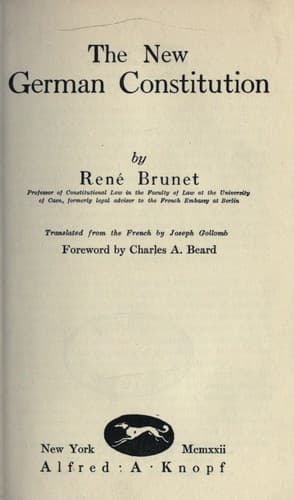
Germany -- Politics and government -- 1918-1933; Germany. Verfassung (1919)
In the terminology of Weimar, the Ministry is called the “National
Cabinet.” Article 52 says, “The National Cabinet consists of the
National Chancellor and the National Ministers.” There is thus stated a
difference--fundamental in the German system--between the Chancellor and
the Ministers.
It will be recalled how the Cabinet of the old Empire was organized. The
Chancellor, properly speaking, was the only Minister; and the Secretaries
of State, by whom he was assisted or represented, were simply high civil
servants absolutely subordinate to the Chancellor. These Secretaries
of State never met together to deliberate on public affairs; each of
them freely decided on the affairs of his department and executed them.
But the Secretaries of State had to refer to the Chancellor every time
that a difference of opinion arose between their departments over
any contemplated law or any administrative measure whatever. Such a
discussion was often prolonged for months, because the Chancellor was
not in a situation to express an opinion, nor to pronounce on the very
complex problem. This was the _bureaucratic_ system.
For this system, with its obvious inconveniences, von Delbrück proposed
to substitute a _collegiate_ one. The Ministers form a Cabinet, to which
all questions concerning general policy or involving the province of
their several departments are submitted. The Prime Minister is only the
first among them, _primus inter pares_; the decision is made by the
whole Cabinet, which naturally assumes the whole burden of responsibility.
The Constituent Assembly supported an intermediate solution, which
partook both of the bureaucratic system and the collegiate. It adopted a
sort of _limited collegiate_ system. The Chancellor is not as formerly
the only Minister of the Reich; he is Minister by the same title as the
other members of the Cabinet, but he has a character distinct from those
of the other Ministers. Without being a hierarchic superior over these he
is on another plane and enjoys certain rights in comparison to the others.
This distinction established by the Constituent Assembly, between the
two elements of the government, the Chancellor on the one hand and the
Ministers on the other, is manifested in the three respects in the
nomination of the ministers, their prerogatives and their responsibility.
Public-domain text, read in full here on John Shaqi.
Reviews
Reviews
No reviews yet
Be the first to share your thoughts on this work.
Elsewhere in the archive
Join the Discussion
Join the discussion
Sign in to leave a comment or review.
Sign InorCreate an account