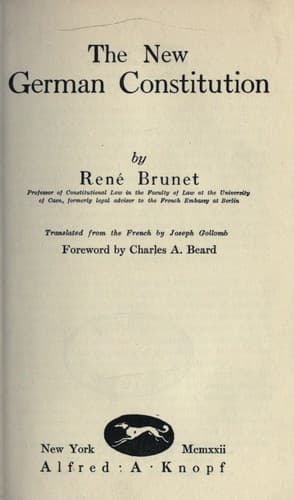
Germany -- Politics and government -- 1918-1933; Germany. Verfassung (1919)
(1) They are nominated in a different manner. The Chancellor is nominated
by the President of the Reich who naturally must be guided therein by the
political situation. According to circumstances, the President is obliged
to nominate some party leader of the group forming the majority of the
Reichstag; or his choice may be exercised among several political figures
according to the combination possible among the parties of the majority.
It is true that the Ministers are also appointed by the President of
the Reich, but _on the nomination by the Chancellor_, and it seems
that in practice the President is always bound by this consideration.
The Chancellor may not be recalled; his functions cease only through
resignation or because he is unseated by the majority of the Reichstag.
The Ministers, on the other hand, may be recalled and the decision may
be taken here, too, by the President of the Reich on the proposal by the
Chancellor.
(2) In regard to powers there exists a still more profound difference
between the Chancellor and the Ministers. The principle is this: the
Chancellor determines and alone determines the general course of the
Cabinet’s policy. The other Ministers direct the affairs of their
respective departments along the lines fixed by the Chancellor in his
general policy. (Article 56.) In other words, it seems that the German
Constitution, without expressly saying so, wants to establish the classic
distinction between “governing” and “administering.” The Chancellor
governs, the other members of the Cabinet administer. This essential
distinction recurs more or less clearly enunciated in all the provisions
relative to the powers of the Ministers.
The latter have as their most important function the exercise of those
powers of which the President of the Reich is the chief holder. They
prepare and countersign the ordinances of the President. But do they
all indiscriminately countersign all decrees and may each Minister
countersign any of the decisions of the President? Not in the least. The
Chancellor countersigns all decisions touching the general policy of the
Cabinet, but he is also authorized to sign other decrees. The Ministers
countersign only the decrees that effect their respective departments.
From this results the following: When a decree of the President is
countersigned by a Minister it may be considered that the Cabinet holds
it to be a purely administrative matter. Every decision presenting a
certain political importance is either countersigned by the Chancellor
only or by both the Chancellor and the Minister whose department is
affected. The Ministers have in the second place their own powers. They
make general or individual decisions which they sign themselves. These
decisions are of two kinds: some of them must be deliberated on and
decreed in the Council of Ministers; other decisions are taken by the
Ministers individually.
Public-domain text, read in full here on John Shaqi.
Reviews
Reviews
No reviews yet
Be the first to share your thoughts on this work.
Elsewhere in the archive
Join the Discussion
Join the discussion
Sign in to leave a comment or review.
Sign InorCreate an account