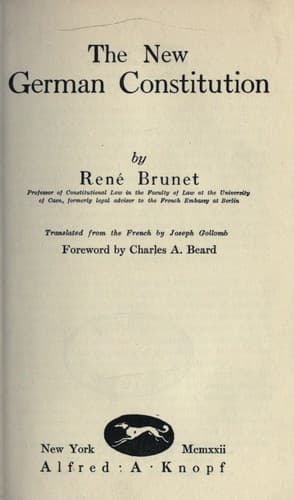
Germany -- Politics and government -- 1918-1933; Germany. Verfassung (1919)
There are above all powers which the Ministers exercise in the Council
of Ministers, and it is here that the mixed character of the regulations
provided by the Constitution is revealed still more clearly. The
predominant position accorded the Chancellor comes from the fact that he
presides over the Council of Ministers--when the President of the Reich
is not present; and the fact that in case of a tie he decides. It may
be asked if the Chancellor can be put in the minority and what would
result from such a situation. Theoretically, according to the _collegiate
principle_, a decision adopted by the majority must always be executed.
But it seems that the Ministry cannot go against the opinion of the
Chancellor, who alone has the right to fix the general lines of policy
and who in addition can always exercise the threat of resigning, which
would thereby involve the fall of the whole Ministry. The Council of
Ministers has its own order of procedure which must be approved by the
President.
On the other hand, the collegiate system is found to be very widely
applied in the ensemble of the provisions vesting in the Council of
Ministers some of the most important powers that properly belong to
Ministers. The Chancellor fixes the general course of the policy to be
pursued by the government; but the Ministers must see to it that in
their various departments the policies practised conform to this general
course, as well as that their individual policies do not conflict with
the interests or the policies of other departments. Also the Constitution
itself enumerates a certain number of matters which cannot be dealt with
except in the Council of Ministers; and it provides that ordinary laws
may extend the number and character of these matters. They are as follows:
(1) All projects of law. In contrast to what occurs in France,
it is not the chief of state who has the initiative in laws but
the Council of Ministers. All projects of laws emanating from
the Cabinet must be discussed and drawn up in the Council before
being sent to the Reichstag.
(2) All matters that touch the domains of the authority of the
various Ministers, and on which the latter cannot privately come
to an agreement.
(3) The power to issue ordinances. In Germany there is no organ
that has general authority to make all ordinances. A particular
organ can only prescribe ordinances within its own limits and
to the end assigned to it by the Constitution or ordinary laws.
We have seen that such is the case for the President; and such
is also the case for the Cabinet. The Cabinet of the Reich may
prescribe regulations of three kinds:
(_a_) Sometimes the Cabinet of the Reich has authority to
prescribe _only_ a regulation. This is particularly the case
when it has to prescribe administrative measures of the general
character necessary for the execution of a law. (Article 77.)
Public-domain text, read in full here on John Shaqi.
Reviews
Reviews
No reviews yet
Be the first to share your thoughts on this work.
Elsewhere in the archive
Join the Discussion
Join the discussion
Sign in to leave a comment or review.
Sign InorCreate an account