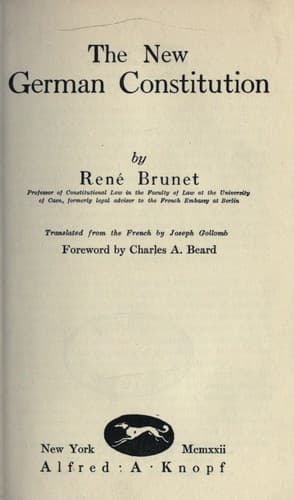
Germany -- Politics and government -- 1918-1933; Germany. Verfassung (1919)
(_b_) Sometimes the Cabinet cannot prescribe a regulation except
with the _approval of the Reichsrat_. This is particularly the
case in the circumstances aimed at in Articles 88, 91, 77, par. 2
of the Constitution.
(_c_) Finally, the law of April 17, 1919, “On a simplified
form of legislation relative to economy during the period of
transition,” gives to the Cabinet of the Reich the power under
certain conditions to enact by means of decrees what amount to
veritable laws. According to this law, the Cabinet may prescribe
regulations having the force of law, and consequently may even
modify laws previously made on condition that it has the _consent
of the Reichsrat and of a committee of twenty-eight members named
by the National Assembly_. The Ministers finally have powers
which they exercise individually. They are in theory purely
administrative powers.
(3) The distinction established by the Constitution between the
Chancellor and the Ministers recurs in the matter of their political
responsibility. Their rôles being different, it is logical that their
responsibility operate under different conditions.
The Chancellor and the Ministers are equally responsible before the
Reichstag. They “require for the administration of their offices the
confidence of the National Assembly. Each of them must resign if the
National Assembly by formal resolution withdraws its confidence,” says
Article 54. To follow the letter of this article it may be believed that
there is not a collective responsibility and that only those Ministers
must resign against whom a vote of want of confidence is passed. However,
that does not seem to be the real meaning of Article 54. This becomes
more clear when one compares it with Article 56. These two articles
together indicate the following. The Chancellor and the Ministers are
responsible to the Reichstag in the same way, but the provinces of their
responsibilities are different. The Chancellor is responsible for the
general course of policies, that is to say, for principles and plans
of great scope, to the exclusion of administrative measures. On the
other hand, the Ministers are responsible not for the general course of
policies but for the manner in which they direct their departments. In
addition the political responsibility of all the Ministers is involved in
decisions taken by them in the Council.
As for criminal and civil responsibility the Chancellor and the Minister
are placed on the same footing, and are answerable for criminal and civil
offences under the same conditions as the President of the Reich.
2.--THE WORKING OF CONSTITUTIONAL RULES; HOW A MINISTRY IS FORMED, WORKS,
AND IS DISSOLVED.
Public-domain text, read in full here on John Shaqi.
Reviews
Reviews
No reviews yet
Be the first to share your thoughts on this work.
Elsewhere in the archive
Join the Discussion
Join the discussion
Sign in to leave a comment or review.
Sign InorCreate an account