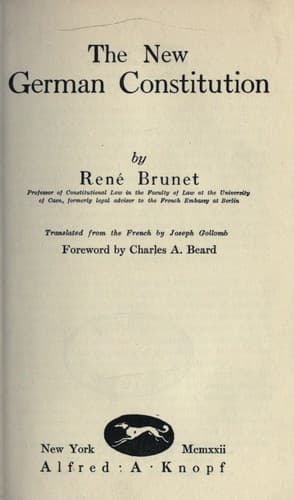
Germany -- Politics and government -- 1918-1933; Germany. Verfassung (1919)
The texts of the laws of October 28, 1918, were accompanied by a letter
of the Emperor to the Chancellor in which he wrote: “Prepared by a series
of governmental acts a new order comes into being in which fundamental
rights of the Emperor pass to the people. After the events of these our
times the German people must not be denied a single right that is needed
to guarantee them a free and happy future. I acquiesce together with my
highest colleagues in the decisions of the representatives of the people
and do so with the firm determination to co-operate to the greatest
effectiveness, convinced that I will thus serve the welfare of the German
people. The Emperor is at the service of the people.”
German jurists with good reason characterized this letter as a “political
abdication.” But the changes which went with it came too late, and
a simple “political abdication” appeared thereafter as strikingly
insufficient. The German Empire was falling into ruin and it was no
longer a question of partial reforms.
2.--THE FALL OF THE OLD RÉGIME.
Revolution broke out in Germany at the beginning of November, 1918.
From the end of October riots and revolts had been taking place on board
the vessels of the Imperial navy. But on November 4 at Kiel there broke
out a revolt among the sailors, who became masters of the situation. They
formed a Council of Soldiers which presented to the mayor of the city a
list of demands--the liberation of arrested sailors; the suppression of a
military hierarchy outside of the service; a demand that the approval of
the Council of Soldiers be necessary for all military measures, etc.
The next day the workers of Kiel declared a general strike and formed
Workers Councils which united with Councils of Soldiers consisting of the
marines of the city.
From Kiel the movement spread the same day to Lübeck and to Hamburg. On
the 6th, a general strike was proclaimed in the dock yards of Hamburg and
revolution broke out in Bremen.
Simultaneously revolution won other cities: Hanover, Cologne, Magdeburg,
Brunswick, Leipzig, and Dresden, where Councils of Workers and Soldiers
were formed. From November 4th to the 9th all North Germany, the South
and the Centre fell into the hands of the Councils.
The movement, which at its beginning could be considered as principally
a military revolt, took on for the first time a political character most
clearly marked in Munich, where in the night of the eighth of November
after a great manifestation by the Independent Socialists serious
disturbances broke out. The royal family was expelled and the Republic
proclaimed.
Public-domain text, read in full here on John Shaqi.
Reviews
Reviews
No reviews yet
Be the first to share your thoughts on this work.
Join the Discussion
Join the discussion
Sign in to leave a comment or review.
Sign InorCreate an account