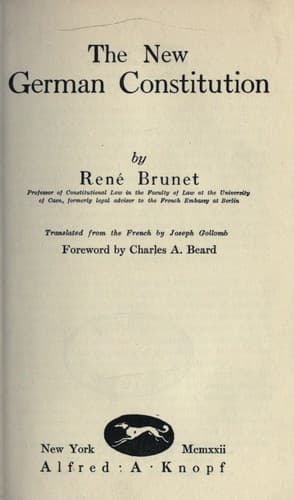
Germany -- Politics and government -- 1918-1933; Germany. Verfassung (1919)
With few exceptions the revolutionists met with no opposition. The
bourgeoisie did not react. It was enough for some thirty marines from
Kiel to enter a town or for a group of soldiers returning from the
fighting front to present themselves at the city hall. Immediately
every one yielded to their orders and the Councils were able to install
themselves in power without firing a shot. In this revolution, to which
no serious opposition had been presented and which appeared rather as the
collapse of an old régime whose reason for existence had vanished, there
lacked only to complete it the fall of the capital and the abdication of
the monarch.
At Berlin the military power devoted itself to the defence of the city.
On the fifth a state of siege was proclaimed and on the seventh a decree
forbade the formation of Councils of Soldiers and of Workers “on the
Russian model.”
But the same day the Social Democrats sent to Chancellor Maximilian of
Baden the Secretary of State Scheidemann, the bearer of an ultimatum
demanding the immediate abrogation of the decree forbidding meetings;
such a transformation of the government of Prussia that those in control
of it should be of the same political complexion as the majority of
the Reichstag; the strengthening of the Social Democratic influence
in the government; and finally the abdication of the Emperor and the
renunciation by the Crown Prince of all claims to the throne.
Although confronted with imminent revolution only officials and
functionaries were overthrown. The bourgeoisie here as elsewhere looked
on passively and attempted no resistance.
As for Maximilian of Baden he hoped to find a basis for negotiation. He
pondered measures to parliamentarize still further the old government
and contemplated the immediate convocation of a constituent assembly to
develop a new constitution. Meanwhile he did not reply to the ultimatum
of the Social Democrats. Whereupon there were organized Councils of
Workers and Soldiers in Berlin who made themselves felt with their first
act on the morning of the ninth of November by declaring a general
strike.
The Chancellor could no longer delay action. On the ninth at two o’clock
in the afternoon, after a telephonic conversation with William II, he
announced officially that the Emperor had abdicated and that the Crown
Prince had renounced the throne. He declared that he, Maximilian of
Baden, would remain in office until the installation of the Regent. He
would propose to the Regent the nomination as Chancellor of the Social
Democratic leader Ebert, and the convocation of electoral colleges with
the view of choosing a national constituent assembly to which would be
given the task of directing the future of the state.
Thus the Chancellor hoped to the last moment to effect in an almost legal
manner the transition from the old to the new Germany. But the pressure
of events was too strong for him and he was not able to realize his hope.
Public-domain text, read in full here on John Shaqi.
Reviews
Reviews
No reviews yet
Be the first to share your thoughts on this work.
Join the Discussion
Join the discussion
Sign in to leave a comment or review.
Sign InorCreate an account