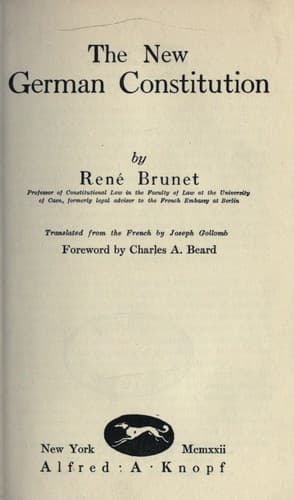
Germany -- Politics and government -- 1918-1933; Germany. Verfassung (1919)
Being obliged to work, is the individual at least master of the product
of his toil? May he dispose of his property as he wishes? No longer. As
with his work, the _individual must place his property at the service of
the community_. And the same idea that has resulted in the restriction of
his liberty to work now leads to a corresponding restriction of his right
over property; “Property rights imply property duties.” (Article 153.)
These restrictions are several kinds.
First, that of _expropriation_. It is true that this was already admitted
in individualist doctrine. But this doctrine hemmed the right of
expropriation on the part of the state within narrow limits, inasmuch as
it prescribed strictly the cases in which the state could use this right,
and provided always the payment of a just and, usually, a previously
ascertained indemnity. These two guarantees given to property owners are
strikingly diminished in the new German constitutional law. On the one
hand, it is true the principle is retained that expropriation must not
be resorted to except for the welfare of the community. But this notion
of general welfare has been particularly elastic. Thus in Article 155
the State is permitted to expropriate in cases of housing crises, in the
interests of settlement and reclamation of land, or in the improvement
of agriculture. Thus the Socialization Law and after it the Constitution
in Article 156 permit the state to transfer to public ownership private
business enterprises adapted for socialization. On the other hand, the
principle of a just indemnity seems to have been retained. However,
there is but one case in which indemnity is imposed and guaranteed by
the Constitution; it is that where the Reich expropriates “the property
of the States, municipalities, and associations of public utility.”
In all other cases the restriction provided in Article 153 applies;
expropriation takes place with indemnity “in so far as is not otherwise
provided by national law.”
In addition to expropriation, the Constitution provides other
restrictions on the right of property:
Land owners are under the _obligation to cultivate it and utilize it_.
However, there is no provision made in case this duty is not carried out.
_The right of inheritance is guaranteed_, but the State has the right to
take part of the inheritance according to provisions determined by the
laws of the Reich, in particular fiscal laws.
_An increase in the value of land_ arising without the application of
labour or capital to the property accrues to the benefit of the community
as a whole.
Public-domain text, read in full here on John Shaqi.
Reviews
Reviews
No reviews yet
Be the first to share your thoughts on this work.
Elsewhere in the archive
Join the Discussion
Join the discussion
Sign in to leave a comment or review.
Sign InorCreate an account