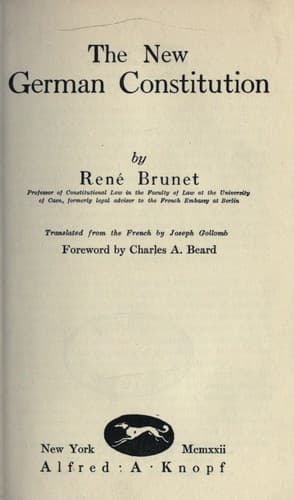
Germany -- Politics and government -- 1918-1933; Germany. Verfassung (1919)
_Entailments_ are dissolved. This provision is an obligatory prescription
imposed on the legislatures of the States, which obliges them to put an
end to entailments, for this matter is given over by the Civil Code to
the rights of States. By entailments is understood the legal institution
by which a patrimony, particularly holdings of land, because of the
limitation of the right to sell and the establishment of a certain
succession provided by a testament, creates for the owning family in the
person of the holder of the entail an economic position of security and
thereby of increased advantage. These entails often go back considerably
in time, but they are very frequent in Germany, to such an extent that
land holdings subject to this legislation comprise, for example, in
Prussia about seven per cent of all the landed properties, with about
two and a half million hectares. In certain sections entailed property
represents about twenty-two per cent of the whole agricultural service.
For a long time now it has been questioned whether this institution,
which tends to the concentration of more and more land into fewer and
fewer hands, should not be abrogated. It is argued in particular against
the entails that the community cannot allow a mere decision taken by the
private will of a proprietor to be perpetuated; that entails have an
unfavourable effect on the distribution of land and that they finally
tend to wipe out the small and the average property. It follows of itself
that with the victory of the democratic idea and in an epoch in which the
tendency is to divide each piece of land as far as possible, entailments
must be dissolved. In leaving to the States the legislation on this
dissolution, the Constitution has only applied logically the democratic
principles on which it rests.[51]
II.--IN TURN THE STATE IS OBLIGED TO FULFIL A CERTAIN NUMBER OF DUTIES TO
THE BENEFIT OF INDIVIDUALS.--The classic individualist doctrine limits
the rights of the State but does not impose upon it any positive service,
no obligation to the benefit of its citizens. The State must abstain from
certain interferences, but the individual may claim no more than that
of it. German constitutional law, however, adopts another conception,
and while it restrains individual rights for the benefit of a community,
it also imposes upon the latter obligations to the profit of the
individual. From this there arise to the profit of the latter new rights
corresponding to the restrictions to which he is subject.
The individual owes the duty of working, but the State owes him the
chance to work, must protect his work and according to circumstances must
furnish him with the necessities of life. From this is derived for the
individual the right to work, the right to the protection of his work and
the right of subsistence.
* * * * *
Public-domain text, read in full here on John Shaqi.
Reviews
Reviews
No reviews yet
Be the first to share your thoughts on this work.
Elsewhere in the archive
Join the Discussion
Join the discussion
Sign in to leave a comment or review.
Sign InorCreate an account