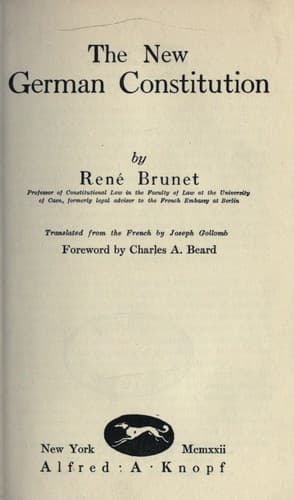
Germany -- Politics and government -- 1918-1933; Germany. Verfassung (1919)
_The State must furnish work to the individual._ This obligation explains
itself very easily. When the individual is left free to use his labour as
he pleases, that is to say, when he is free to work exclusively in the
interests of purely selfish ends, he must also be left the right to look
for such work and to dispose of his labour where and how he pleases. The
community disassociates itself from a work in which it is not directly a
beneficiary or from which it may even suffer. But if it demands of the
individual that he devote himself only to such labour as will benefit the
whole of the nation, and if it forbids him, therefore, a certain number
of occupations which benefit only the individual, it is indispensable
that it take measures to guarantee him sufficient remunerative work.
Article 163, par. 2, provides therefore: “Every German shall have the
opportunity to earn his living by economic labour.”
Of what exactly consists this duty on the part of the State? It is
certainly not a legal obligation that gives the individual the right
to demand before a tribunal the execution of this promise. It is a
promise that the Constitution makes and which it sufficiently fulfils if
the Reich institutes a general system to make known all the available
possibilities for work. An individual may ask only what kind of work is
available and what opportunity there is of securing it. The proposal
of the Socialization Law provided that every German shall receive work
corresponding to his powers. The final text of this law, like that of the
text of the Constitution, limits itself to prescribing that every German
must be given the opportunity to earn his living by economic labour,
that is to say, by labour that produces goods, utilizing to the utmost
the available conditions of work. In addition, the compensation to the
individual must be sufficient for a livelihood.
* * * * *
Public-domain text, read in full here on John Shaqi.
Reviews
Reviews
No reviews yet
Be the first to share your thoughts on this work.
Elsewhere in the archive
Join the Discussion
Join the discussion
Sign in to leave a comment or review.
Sign InorCreate an account