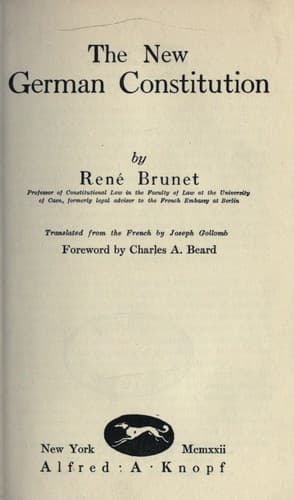
Germany -- Politics and government -- 1918-1933; Germany. Verfassung (1919)
_The State in addition protects labour._ The Socialization Law
declares that the power of labour is the most precious economic good
and it imposes on the Reich the legal obligation to protect it. The
Constitution of Weimar applies in Article 157 the terms of the law of
March 23, with the exception of the words, “the most precious economic
good.” But the Constitution also extends and organizes in outline the
duty of the State in this respect. It amplifies this duty in expressly
specifying in its Article 158 that intellectual labour also is under the
special protection of the Reich. As to the measures for the protection of
labour, some of them come under domestic law, others under international
law. Within the Reich itself the Constitution prescribes the creation of
uniform labour legislation. In addition it guarantees to every individual
and to every vocation the liberty of organization for the defence and
the development of the conditions of labour and of economic life, and
it accords to each employé and laborer the free time necessary for the
exercise of the civil duties and free public functions that may be given
to him. Finally, it promises a complete system of social insurance to
be established for the maintenance of health and standards in labour.
In international relation, the Constitution imposes on the Reich the
obligation to protect abroad the products of German science, art and
technique, and to strive for the establishment of an international
regulation of the legal status of workers.
* * * * *
_Finally the State must provide for the needs of individuals out
of work_; and this obligation logically results from the principle
that inspires all of this part of the Constitution. Since the Reich
imposes on every German the obligation to work only for the good of
the community, it must see to it--apart from any humanitarian or
financial considerations--that every German’s capacity for labour shall
be maintained as long and at as high a standard as possible. That is
why, not content with merely protecting this capacity of labour, the
Socialization Law and the Constitution provide that every German must
receive what is necessary for his livelihood, to the extent that a
possibility of adequate employment cannot be assured to him (Article 163).
The draft of the Socialization Law provided as a condition to this duty
on the part of the State that the individual shall not have been able to
find employment. The final text of the law which the Constitution also
uses provides only that such opportunity for employment shall not have
been offered.
Public-domain text, read in full here on John Shaqi.
Reviews
Reviews
No reviews yet
Be the first to share your thoughts on this work.
Elsewhere in the archive
Join the Discussion
Join the discussion
Sign in to leave a comment or review.
Sign InorCreate an account