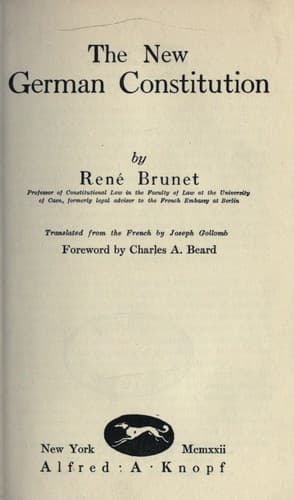
Germany -- Politics and government -- 1918-1933; Germany. Verfassung (1919)
The burden of the proof is thus reversed from the general rule and an
attitude purely passive on the part of the individual in this respect is
sufficient to entitle him to public succour. On the other hand, it is not
sufficient for the discharge of all such obligations on the part of the
State if it merely offers the individual any employment whatsoever. For
it does not serve the community in any way, as the most interested party,
when an individual is employed in work for which he is not fitted. The
community, therefore, must procure work corresponding to the mental and
physical powers of the individual and to his capacity. If the State does
not succeed in doing so, it is obliged to furnish him a livelihood.
* * * * *
To put into operation the principles thus enunciated by the Constitution,
different laws are necessary--a law on the offer of employment, a law
protecting labour, a law on the help to be given to the unemployed. Such
laws have not yet been enacted. However, a certain number of ordinances
have been passed that constitute on the part of the Reich the beginning
of the execution of the new obligations imposed upon it.
First, measures have been taken to procure employment for individuals. To
this end, aside from the ordinance of December 9, 1918, which imposes on
municipalities the obligation of organizing employment bureaus, public
and impartial, there is also an ordinance of May 5, 1920,[52] creating
for the Reich a bureau devoted to finding employment. This agency has
for its principal function a survey of the labour market and the editing
of periodical bulletins on the situation in this market for the purpose
of establishing an equilibrium between supply and demand in the different
regions and in the different vocations.
Measures have been taken also to protect labour. The first step toward
the creation of uniform labour legislation was made by the provisional
ordinance of January 24, 1919, which, supplementing the divisions
of the Civil Code, regulates labour in agricultural and forestry
exploitations.[53] Social insurance legislation, such as is found
codified in the law of the Empire of July, 1911, _i. e._, as sickness,
accident, disability and death insurance, has been supplemented by
different provisions, particularly by a law of December 29, 1919,
relative to the protection of pregnant women.
Public-domain text, read in full here on John Shaqi.
Reviews
Reviews
No reviews yet
Be the first to share your thoughts on this work.
Elsewhere in the archive
Join the Discussion
Join the discussion
Sign in to leave a comment or review.
Sign InorCreate an account