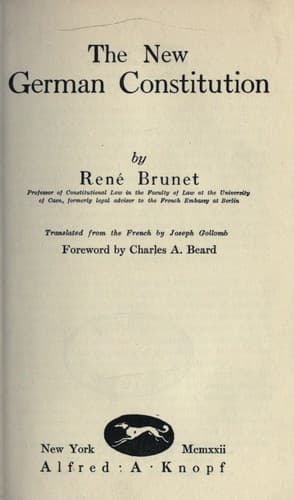
Germany -- Politics and government -- 1918-1933; Germany. Verfassung (1919)
Finally, regarding the obligation to provide livelihood for unemployed,
different ordinances have been issued which were codified by an ordinance
of January 26, 1920.[54] According to these ordinances, the duty of
organizing a service for the supplying of the needs of unemployed--a
service which must not take on the character of charity--falls upon the
municipalities, which are assisted financially by the Reich to the extent
of six-twelfths of the total expense and by the State with four-twelfths
of this expense. The municipalities must refuse this help to those who
do not accept the work offered them, even if this work does not fit the
vocation of the one refusing and even if it must be done away from home,
provided always that this work be adapted to the physical capacity of
the unemployed. The only ground on which one may refuse such work is
that the pay is not sufficient, given local conditions, to support the
individual and, if married, his family.[55]
In the same way that restrictions on the liberty of labour have
created for the State a number of duties relating to the employment of
individuals, so the restrictions on the rights of private property have,
as a consequence, engendered a number of obligations on the part of the
State to assure to every one, if not a minimum of property, at least a
minimum of well-being.
The Constitution guarantees individual property, but on the condition
that the distribution and the utilization of land do not present abuses.
The aim of this is to, “_to insure to every German a healthful dwelling
and … homestead corresponding to his needs_” (Article 155). To this end
colonization must be favoured, the development of agriculture and the
utilization of the soil must be promoted; a survey must be made of all
the mineral resources and all economically useful forces of nature.
In accordance with their conception of the duties of the State, the
Constituent Assembly outlined a vast programme of agrarian and social
policy. In addition they themselves passed several laws which form the
commencement of the execution of this programme and which are intended to
guide future legislation.
In order to insure every German a habitation and a homestead, the
Reich first promulgated a decree, July 31, 1919, “On small gardens
and little farms,” according to which tracts of land, which cannot be
used profitably, must be rented out at rates fixed by administrative
authorities after expert appraisal, or may be leased, and later
sub-leased, for gardens, by the authorities.
Public-domain text, read in full here on John Shaqi.
Reviews
Reviews
No reviews yet
Be the first to share your thoughts on this work.
Elsewhere in the archive
Join the Discussion
Join the discussion
Sign in to leave a comment or review.
Sign InorCreate an account