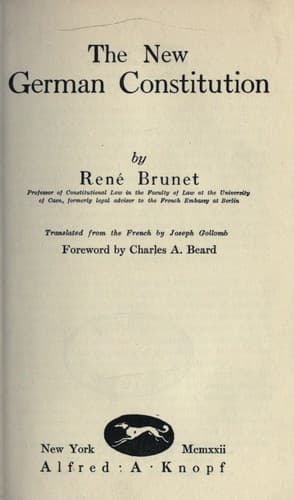
Germany -- Politics and government -- 1918-1933; Germany. Verfassung (1919)
Later the law of April 11, 1919, was passed “on colonization.” This law
obliges the State to create interior colonies and small undertakings.
To this end territory belonging to the State must be put on sale
to “collective colonization enterprises”; these enterprises may be
subsidized by means of expropriations of swamps and uncultivated tracts.
They have the right of pre-emption in the sale of tracts of land of less
than twenty-five hectares. On the other hand, to develop colonization
tracts, there must be organized “associations for the furnishing of
tracts” in all districts where more than ten per cent of the cultivatable
soil is in the hands of big holders, that is, of more than one hundred
hectares per holder. These associations, formed by a union of big
landholders, must, on the demand of collective colonization enterprises,
put at the disposal of the latter at reasonable prices tracts of land
taken from the big properties. Their obligations in this respect cease
when they have thus given over to colonization a third of the utilizable
surface of the large properties, or when the total area of these
properties is not more than ten per cent of the area of the district.
The right of pre-emption by the colonization enterprises in respect to
large properties is exercised through the associations for the furnishing
of tracts. In urgent cases these associations may proceed by means of
expropriation.
The Reich, finally, in order to assure a habitation to individuals,
must take a whole series of measures in the case of housing crises.
Already before the Revolution a decree of September 23, 1918, gave to
municipalities the right to make regulations for the prevention of the
demolition of buildings or their use for other purposes than dwelling.
The municipalities had the right to draw up leases, even against the wish
of the owners, through the intermediacy of “offices for the distribution
of lodgings,” and to appropriate all unused buildings for the purpose
of converting them to dwellings. A later decree of November 7, 1918,
provided that associations of municipalities and groups of municipalities
could be created to fight against housing crises. After the Revolution,
a new decree of January 15, 1919, contained more important provisions
for meeting the most urgent needs created by such crises. The State
Cabinets were obliged to appoint “housing commissioners,” charged with
the care of homeless families and the creation of small and average
appropriate lodgings. To this end, they received considerable powers.
They could expropriate by a summary procedure unoccupied buildings they
deemed necessary, or have such buildings erected on grounds which they
had authority to lease for terms as long as thirty years. They could
dispense with the requirements of legislative provisions, expropriate
tile and other building materials necessary for the rapid construction
of buildings; they could seize building lumber and forbid unnecessary
construction.
Public-domain text, read in full here on John Shaqi.
Reviews
Reviews
No reviews yet
Be the first to share your thoughts on this work.
Elsewhere in the archive
Join the Discussion
Join the discussion
Sign in to leave a comment or review.
Sign InorCreate an account