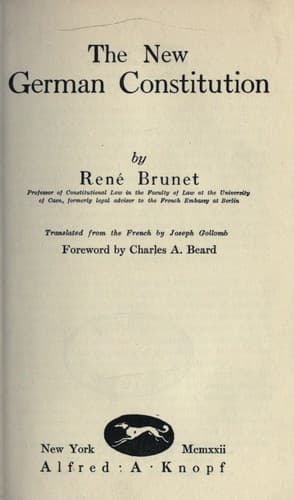
Germany -- Politics and government -- 1918-1933; Germany. Verfassung (1919)
The service of these Housing Commissioners was under the
Minister of Labour for the Reich.
Finally, in order to protect tenants, the ordinances of September 23,
1918, and of June 22, 1919, sanctioned and supplemented by the law of
May 11, 1920, _limit considerably the rights of owners to dispose of
habitable quarters_ and entrust to the “offices for distribution of
lodgings,” extensive rights relative to the renting out of apartments and
the terms of lodgings. In particular, according to the law of 1920, if
grave inconveniences result from the lack of lodgings, the states may,
with the consent of the Minister of the Reich, authorize or constrain
the municipalities to take, or themselves take, measures that constitute
encroachments on the liberty of settlement and the inviolability of
domicile, on condition that these measures be expressly necessary to
meet a housing crisis or to combat it. This law specifies, in addition,
that decisions taken in the fight against the shortage of houses may be
executed by administrative constraint.
3.--FUNDAMENTAL RIGHTS AND DUTIES OF COMMUNITIES.
The Constituent Assembly did not limit itself to the establishment of a
list of rights and duties of the individual. The social conceptions by
which it was dominated led it to proclaim, after the rights and duties of
the individuals, the rights and duties of certain groups and communities
that seemed to it to play a particularly important rôle in society--the
family, associations, municipalities, civil service.
* * * * *
I.--THE FAMILY.--For the first time the family, the natural foundation
of all ordered national life, finds itself mentioned in the Declaration
of Rights of a modern state. The Constitution of Weimar formulates
the general principles which should dominate legislation relating to
marriage, to the education and the protection of children and to the
duties of education devolved upon parents.
Article 119 places marriage under the special protection of the
Constitution. Marriage, which forms the basis of family life and on which
depends the increase of the population of the nation, is based on the
equal rights of both sexes. Marriage and the family are recognized as the
basis on which social life reposes and as the primary source from which
develop German customs and culture. In consequence Article 119 enunciates
a legislative course of considerable social and political importance. It
prescribes the care of the purity, the health and the social advancement
of the family as a duty of the state and of the municipalities. Families
with numerous children have a claim to equalizing assistance. Motherhood
has the right to the protection and care of the State.
Public-domain text, read in full here on John Shaqi.
Reviews
Reviews
No reviews yet
Be the first to share your thoughts on this work.
Elsewhere in the archive
Join the Discussion
Join the discussion
Sign in to leave a comment or review.
Sign InorCreate an account