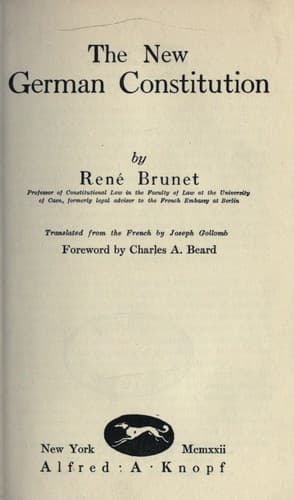
Germany -- Politics and government -- 1918-1933; Germany. Verfassung (1919)
Proposals were made, during the discussion of the draft of the
Constitution, to lighten the lot of illegitimate children. They
were aimed to assimilate, from the point of view of family rights,
illegitimate and legitimate children. The majority of the National
Assembly decided, because of the difficulties of regulating in a
constitutional text questions of private rights, to leave this matter
to legislation and to later development. The Assembly limited itself to
forming guiding principles only. Legislation must assure to illegitimate
children the same conditions for physical, moral and social development
that legitimate children have. But convinced of the need of legislative
reform on this matter, the Assembly passed a resolution that there should
be taken, as soon as possible and by legislative means, a new ordering of
the legal and social status of illegitimate children.
Concerning education, Article 120 declares only that parents have the
right and the duty to educate their children; “The physical, mental, and
moral education of their offspring is the highest duty and natural right
of parents.” But the State must not leave it entirely to parents and
intervenes as an organ of surveillance. The political community watches
over the execution by the parents of these duties imposed upon them.
In addition the State assumes as an obligation in a general way the
protection of youth; the care of children and youth comes under the
legislative authority of the Reich. As a guide for the accomplishment
of this obligation, Article 122 specifies that youth shall be protected
against exploitation as well as against physical and mental neglect.
* * * * *
II.--ASSOCIATION.--The right of assembly and association was already
regulated by the law of April 19, 1908; in addition to this the Civil
Code contained some provisions on the acquisition of civic rights. The
Constitution contents itself with taking as its own the principles that
inspired these laws, but it makes certain changes in the existing laws.
_As to the liberty of assemblage_, Article 123 holds to rules previously
adopted, “All Germans have the right of meeting peaceably and unarmed
without notice or special permission.” The obligation that public
meetings be reported in advance to the authorities, which formerly
existed, is abolished. Furthermore, while the law of 1908 demanded that
public meetings in the open air and manifestations on public ways and
squares receive in advance authorization by the police--authorization
which must be applied for at least twenty-four hours in advance--the
Constitution, on the other hand, declares that _in theory_ these meetings
are free and do not need to be authorized. It adds, however, that in
the interest of security and public order, liberty of assembly may be
limited by law, this limitation consisting furthermore not in the need of
authorization, but only in the obligation to give the police notice in
advance.
Public-domain text, read in full here on John Shaqi.
Reviews
Reviews
No reviews yet
Be the first to share your thoughts on this work.
Elsewhere in the archive
Join the Discussion
Join the discussion
Sign in to leave a comment or review.
Sign InorCreate an account