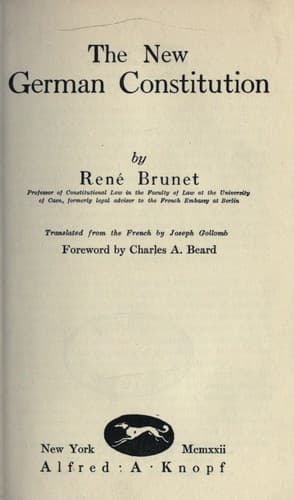
Germany -- Politics and government -- 1918-1933; Germany. Verfassung (1919)
_As to liberty of association_ the Constitution still holds to the
principle of the regulations of 1908. “All Germans have the right
to form associations or societies for purposes not contrary to the
criminal law. This right cannot be limited by preventive measures.”
(Article 124.) Associations may acquire a legal status according to the
regulations provided by the Civil Code. Hitherto these regulations gave
administrative authorities the right to oppose the acquisition of legal
status by associations of a political, social or religious character.
This opposition resulted in the associations in question being kept from
the register of associations, and thereby prevented them from acquiring
legal standing. This restriction is abolished by the Constitution
as contrary to the modern principle according to which liberty of
association must be kept intact. To this effect it is expressly provided,
“Every association has the right of incorporation in accordance with the
civil law. No association may be denied this right on the ground that it
pursues a political, social-political, or religious object.”
* * * * *
III.--MUNICIPALITIES.--Article 127 provides, “Municipalities and
unions of municipalities have the right of self-government.…” Thus
the _principle of decentralization_ is found introduced in the list of
fundamental rights.
The Constitution declares that this autonomy must be exercised “within
the limits of the laws.”
* * * * *
IV.--CIVIL SERVANTS.--Finally, the Constitution reaches the question of
civil servants, to which it devotes no less than six articles.
Before the Constitution went into effect, the status of civil servants of
the Empire was regulated by the law on civil servants, March 31, 1873,
as amended by the law of May 18, 1907. The new Constitution left this
law intact, but it superimposed a series of general rules, some of which
were borrowed from the preceding laws applying to the civil servants of
the Empire, and which are destined hereafter to hold good for all German
civil servants, as well as those of the states and of public corporations.
The principles that serve as a point of departure are: that civil
servants are in the service not at all of the party in power, but of the
community; that, therefore, civil servants who remain faithful to the
community all their lives have the right to be kept in office for life
and to have guaranteed them a financially adequate situation; finally
that outside of his office every civil servant is neither more nor less
than any other citizen. These principles the Constitution applies in
the provisions relative to the free access of all citizens to public
functions, to the political liberty of civil servants and finally to
their financial responsibility.
Public-domain text, read in full here on John Shaqi.
Reviews
Reviews
No reviews yet
Be the first to share your thoughts on this work.
Elsewhere in the archive
Join the Discussion
Join the discussion
Sign in to leave a comment or review.
Sign InorCreate an account