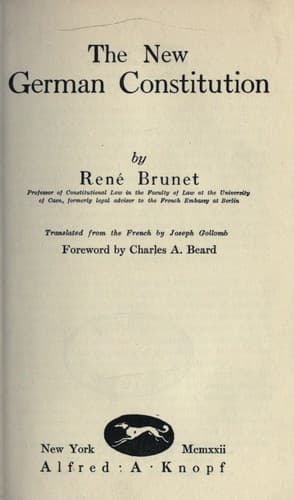
Germany -- Politics and government -- 1918-1933; Germany. Verfassung (1919)
In addition a certain number of interesting innovations have been
enacted into legislation. These have as their purpose the participation
by parents and pupils in the administration of schools. On the one
hand, in the secondary schools there are organized Students’ Councils
(Schulgemeinden). These Councils are formed by pupils of the three upper
classes, who meet periodically in assembly to discuss questions of
instruction--educational matters, quarterly reports, discipline, duties,
etc. Teachers attend these meetings without the right to vote. Up to now
these assemblies have had only the right to propose reforms without power
as yet to make them operative. On the other hand, parents elect for each
school a Parents’ Council, one member for every fifty pupils.[56] This
Council concerns itself mostly with classes, examination and discipline.
If a pupil has committed a fault involving the possibility of expulsion
from the schools, it is before this Council that this question is taken.
Teachers are sometimes admitted to these deliberations but have not the
right to vote.
CHAPTER VI
THE ECONOMIC CONSTITUTION AND SOCIALIZATION
The Constitution imposes on each German the duty of work. It is not
sufficient in modern states, especially in one defeated in war, that
every one therein merely work, unless this work is directed in a
certain spirit, following a given plan and toward a determined end. The
fundamental idea that inspired the Constituent Assembly in the last
provisions of its work is as follows: The whole German system of economy,
public and private, is destroyed or demolished by the war. Germany cannot
dream of rising from its ruins unless it realizes immediate and radical
reforms. It must completely reconstruct its former economic system. The
whole country must become an immense enterprise directed by a conscious
will aimed at a definite goal. All the forces of the country solidly
organized and scientifically utilized must be so managed that a maximum
of production will be assured.
To this end, two series of reforms are contemplated. They are summed
up in these words, “councils” and “collective economy.” On the one
hand, there is projected an Economic Constitution, whose organs are
progressively destined to be parallel to those of the political
Constitution. On the other hand, the effort is made to realize in the
organization of production and distribution an economic system that is
intermediate between that of private economy on the one hand, and a
purely socialist régime on the other.
Public-domain text, read in full here on John Shaqi.
Reviews
Reviews
No reviews yet
Be the first to share your thoughts on this work.
Elsewhere in the archive
Join the Discussion
Join the discussion
Sign in to leave a comment or review.
Sign InorCreate an account