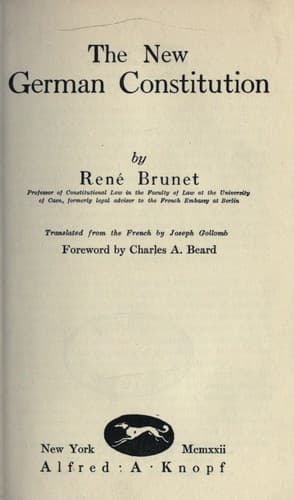
Germany -- Politics and government -- 1918-1933; Germany. Verfassung (1919)
Naturally there was no longer any question of the Emperor. Having lost
his crown on November 9, he fled across the Dutch frontier on the 10th,
as a private individual and his letter from Amerongen on November 28,
1918, in which he, William II, declared that he expressly renounced for
all time the crown of Prussia and thereby “the Imperial German crown,”
had only, so to speak, a moral effect.
After the resignation of Maximilian of Baden there was no longer a
Chancellor of the Empire. It is true that he had passed on his powers to
Ebert but we will see shortly that Ebert did not consider himself as such
except for a few hours.
As for the Reichstag whose last session ended on October 26, 1918, it was
not exactly dissolved after the revolution. At the same time no formal
dissolution was necessary, for a new sovereignty had been installed and
had taken the place of the old Reichstag. Meanwhile, taking advantage of
the fact that no formal decision had been made as to the old Reichstag
the chairman of that assembly, Fehrenbach, refused to recognize its
implied dissolution. On November 12, 1918, he addressed a circular to the
deputies in which he declared that owing to the exigencies of the hour
and without the consent of the government he would convoke the Reichstag,
reserving to himself the right to announce later the time and place of
the assembly. The revolutionary government thereupon notified Fehrenbach
that a conflict would ensue thereat. Notwithstanding this Fehrenbach
several days later repeated the announcement of the convocation. But the
old Reichstag never met again. In February, 1919, it was dissolved by
decree which also declared that its last session was dated as of November
9, 1919.
3.--THE REPUBLIC OF THE COUNCILS.
While the Empire was collapsing there arose quickly on the ruins of the
old edifice a new structure. In place of the Empire, the government
of a bourgeois and military oligarchy, came the dictatorship of the
proletarian masses at one blow, the republic of the working class.
Everywhere Councils of Workers and Soldiers were formed, which, taking
political power in their hands, appeared to be thereafter the only and
real holders of sovereignty.
Public-domain text, read in full here on John Shaqi.
Reviews
Reviews
No reviews yet
Be the first to share your thoughts on this work.
Join the Discussion
Join the discussion
Sign in to leave a comment or review.
Sign InorCreate an account