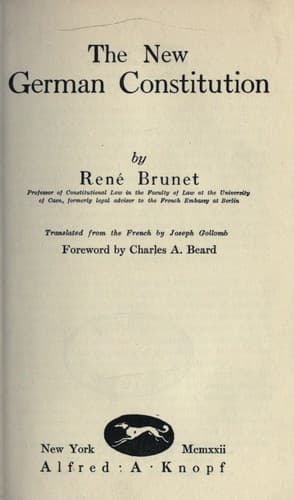
Germany -- Politics and government -- 1918-1933; Germany. Verfassung (1919)
In the early part of the afternoon, Ebert accompanied by Scheidemann
appeared at the Chancellery and declared in the name of their party that
in order to avoid bloodshed and to maintain public order they considered
it necessary to take power in their hands and assume the direction of the
government. When Vice-Chancellor von Payer asked Ebert if he intended
to conduct the government on the basis of the Constitution or in the
name of the Councils of Workers and Soldiers, Ebert replied, “Within the
frame work of the constitution.” After short deliberation and in view of
the fact that the troops in Berlin had deserted the old government the
cabinet of Maximilian decided to place in the hands of Ebert the powers
of Chancellor of the Empire “subject to the approval of the legislature.”
Ebert at once entered into office without the question of the regency
being decided.
But the Socialist parties pressed for the proclamation of a republic.
This proclamation took place several minutes after the installation of
Ebert as Chancellor. In answer to the clamor of a great gathering of the
people in front of the Reichstag Scheidemann appeared on the terrace and
declared in substance, “We have conquered everywhere along the line.
The old régime is no more. Ebert is Chancellor. Our deputy, Lieutenant
Göhre, is associate minister of war. We must now strengthen our victory
and nothing will stop our march. The Hohenzollerns have abdicated. Let
us see to it that this magnificent day is marred by nothing. May this be
a day of eternal glory in the history of Germany. Long live the German
Republic!”
The same day and almost the same hour similar events took place in all
the states of Germany. Everywhere under the threat and under the pressure
of the Councils of Workers and Soldiers the old Diets and the old
governments vanished. The kings, the grand dukes and the dukes resigned
or were simply replaced. The republic was proclaimed. One can say that on
November 9, 1918, when at two in the afternoon in front of the Reichstag
Scheidemann proclaimed the Republic, the ancient régime had fallen in
Germany.
* * * * *
From this date on all the organs of government which had incarnated the
old régime disappeared or were entirely transformed.
The Bundesrat, in which the sovereignty of the old Reich was
incorporated, ceased to exist as such. It is true that the new leaders
of the Reich permitted the Bundesrat “the right to continue the exercise
of administrative powers according to laws and regulations” (decree of
November 14, 1918); and thus there continued a Bundesrat of limited
power. But it was no longer the old Bundesrat, for the governments of the
individual states, having changed through revolution, sent new delegates
who no longer represented princes but republics.
Public-domain text, read in full here on John Shaqi.
Reviews
Reviews
No reviews yet
Be the first to share your thoughts on this work.
Join the Discussion
Join the discussion
Sign in to leave a comment or review.
Sign InorCreate an account