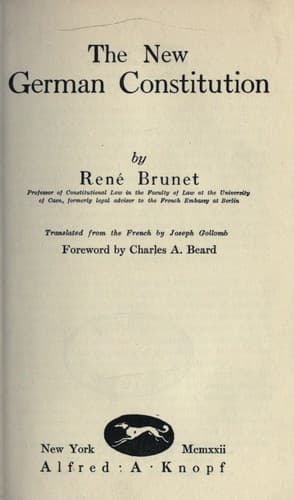
Germany -- Politics and government -- 1918-1933; Germany. Verfassung (1919)
But an increasingly important part of the working class, attracted by
the ardent propaganda of the theoreticians of the Councils system,
physically and mentally depressed by misery and unemployment, irritated
by the mistakes of the Cabinet and disillusioned by the impotence of the
Assembly of Weimar, rallied to the doctrines of the Councils. The Trades
Unions were no longer believed by them able to lead the battle which
would assure to the workers the preponderant rôle which should be theirs
in economic matters. They showed during the war, co-operating with the
militarists and the bureaucrats of the Empire, that they were always
ready to compromise. They were directed by veritable functionaries, whose
whole careers developed within the Trades Union administration and who
had no qualification for representing the working class. In order to
secure what the working class wants these claims must be taken in hand
by organs issuing directly from the workers--militant organizations in
position to lead a swift energetic fight--these organs being the Workers
Councils. _The Councils must be placed above the unions_, and it is to
them that belongs the right to decide on the campaigns that should be
waged.
Between these two opposite conceptions there arose an intermediate
theory. The trades unionists of the later school and the Christian Trades
Unionists, energetically as they rejected all economic dictatorship by
the Councils, held, however, that there is something just and legitimate
in such theories. Giesbert, who holds an important situation in the
Christian Trades Unions and who was to be Minister of Posts, wrote in
April: “We have not sufficiently appreciated and above all we have
realized too late the degree of sound truth in the idea of the Councils.
The reason for this is that this idea has come to us from Russia as a
political conception, and also because it arrived accompanied by all
the tragic manifestations of the Russian Revolution. If the system of
Councils assures to the workers the right to participate more completely
in the organization and development of economic life, then it cannot
help but contribute, if this is done in a reasonable manner, to the
reawakening of the love of work and the establishment of a close
community of interests between employers and employés.”[60]
As for the Cabinet, it declared itself from the first against the
Councils, and in an official communication on February 26, 1919,
Scheidemann, President of the Council of Ministers, declared that the
Cabinet never considered the introduction of the Councils System in
Germany, and that above all, if any part should be accorded the Councils,
it could only be that of an intermediary between the employers and the
trade unions.
Public-domain text, read in full here on John Shaqi.
Reviews
Reviews
No reviews yet
Be the first to share your thoughts on this work.
Elsewhere in the archive
Join the Discussion
Join the discussion
Sign in to leave a comment or review.
Sign InorCreate an account