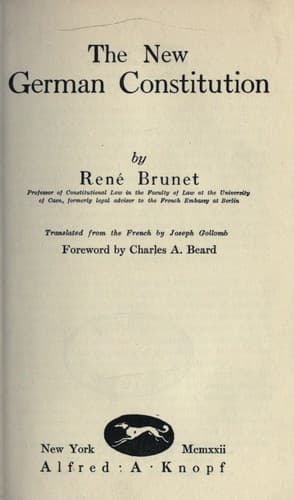
Germany -- Politics and government -- 1918-1933; Germany. Verfassung (1919)
But it soon became impossible for either the Cabinet or the Trades
Unions to remain in this almost completely negative position; for the
struggle for the _Mitbestimmungsrecht_ ceased to be merely a debate among
theoreticians. At the beginning of March the workers in the metallurgical
industry declared a general strike in Berlin; and in April the miners of
Central Germany did the same.
The Cabinet found itself forced to modify its point of view. Receiving
at Weimar a delegation of strikers come to present an ultimatum to him,
Scheidemann recanted the communication of February 26, and engaged
himself by a written promise to effect the recognition of the principle
of Councils in the Constitution.[61] One month later he fulfilled his
promise. On April 5, a new note made known under what conditions and
to what extent the Cabinet envisaged the possibility of organizing and
utilizing the Councils. He proposed to inscribe in the Constitution an
article proclaiming in general terms the right of workers to participate
in common and on equal terms with employers in the regulation of
questions of wages and work, as well as in the development of the forces
of production in the common economic interest. By the side of special
Workers Councils there were to be mixed Councils which would have general
economic authority.
On their side the Trades Unions also found themselves obliged to seek
a working basis, and they concluded by agreeing to the introduction
of Councils in German economic life, on the condition that a very
sharp separation be marked between the powers of the Factory Workers
Councils and the Economic Councils on the one hand, and those of the
Trades Unions themselves on the other. Another condition was that
assurance must be given the Trades Unions that the _Workers Councils
would fulfil their mission in accord with the Trades Unions_. At the
Congress of Nuremberg, July, 1919, the Trades Unions engaged themselves
to use their whole influence to secure for the workers and employés the
_Mitbestimmungsrecht_ in the various industries and to help the Factory
Workers Councils to play an effective part.
2.--CONSTITUTIONAL PROVISIONS RELATIVE TO THE COUNCILS.
It was agreed, then, to recognize for wage-earners and salaried employés
the right of co-operation in the conduct of industries and that all
parties to the productive organization of the nation must co-operate in
the regulation of economic questions. This idea is developed and in part
realized in the provisions of Article 165, which form the foundation of
the future Economic Constitution.
Public-domain text, read in full here on John Shaqi.
Reviews
Reviews
No reviews yet
Be the first to share your thoughts on this work.
Elsewhere in the archive
Join the Discussion
Join the discussion
Sign in to leave a comment or review.
Sign InorCreate an account