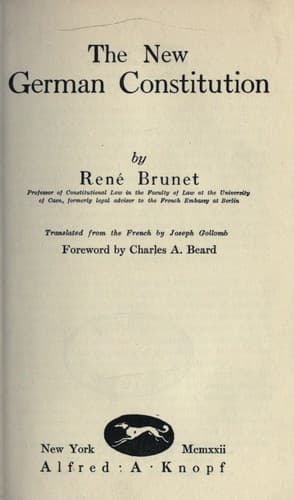
Germany -- Politics and government -- 1918-1933; Germany. Verfassung (1919)
The development of these organisms since the revolution seems to support
their opinion. On the basis of agreements concluded in December, 1918,
the _Arbeitsgemeinschaften_ have taken on considerable extension.
Little by little the organisms provided by the statute of December
4, 1918, have been created and expanded. Not only have individual
_Arbeitsgemeinschaften_ been established between employers’ and
employés’ organizations, but these have also been formed into larger
groups. For example, the _Arbeitsgemeinschaft_ of the Ruhr mines, those
of the Sarre, of Saxony and of Upper Silesia have united into a central
_Arbeitsgemeinschaft_, that represents the interests of the whole coal
mining industry of Germany. It is administered by a Central Council
composed, of course, of equal numbers of employer and worker delegates.
A great number of other industries have organized on the same model
and they, too, have added above the local organs a Central Council
that represents the general vocational interests. Finally, the Central
Committees of the different industries have joined and thus created on
December 12, 1919, a central _Arbeitsgemeinschaft_, which constitutes
the supreme organization and which is charged with settling by direct
agreements between employers and employés and on a parity basis all the
problems that touch the life of the industries and trades in Germany.
This is sub-divided into fourteen vocational groups: iron, provisions,
construction, textile, clothing, paper, leather, transports, glass and
ceramics, chemistry, oils and fats, forest and land workers, mines and
lumber. The Central Executive Committee (Central Vorstand) is composed
of twenty-three members chosen by the employers and twenty-three by the
workers. Other Committees are created on which the Central Committee
places part of its work. Seven such have already been constituted, on the
study of wages, labour legislation, economic policy, raw material, coal
and transports, tariffs, the execution of the treaty of peace and the
internal regulations of the _Arbeitsgemeinschaft_.
All this movement, say the trade unions, represent undeniable progress.
For the hostile interests of employer and employé is substituted the
_interest of the vocation as a whole_, which creates in the employers
and workers of the same vocation a consciousness of the community of
their interests and engenders among the different industries a fruitful
rivalry. In uniting the _Arbeitsgemeinschaften_ of all the industries,
conflicting interests are placed in equilibrium and neutralized and there
remains only common consciousness of national interests.
Public-domain text, read in full here on John Shaqi.
Reviews
Reviews
No reviews yet
Be the first to share your thoughts on this work.
Elsewhere in the archive
Join the Discussion
Join the discussion
Sign in to leave a comment or review.
Sign InorCreate an account