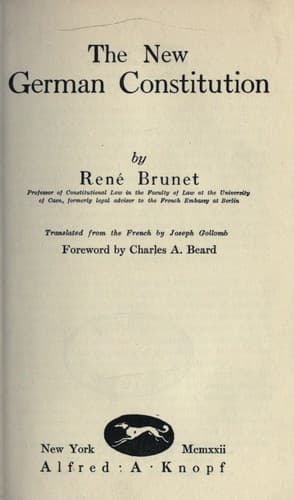
Germany -- Politics and government -- 1918-1933; Germany. Verfassung (1919)
It must be observed that up to then the change which had been brought
about constituted without doubt a revolution, but a revolution remarkably
moderate. It is true that constitutional right did not give the
Chancellor the authority to name his successor; from the legal point of
view the nomination of Ebert certainly constituted a violation of the old
constitutional law. Nevertheless in its outer aspect the new government
with Ebert at the head sought to appear as the expression of the will of
the former government. The idea of a radically new law had not yet made
its appearance.
In the course of a few hours, however, the situation completely changed.
The Independents submitted as the condition of their entry into the
government the following twofold demand: The cabinet was to consist
only of socialists, and it was to recognize officially that political
sovereignty resided in the hands of the Workers and Soldiers Councils.
The next day the Social Democrats accepted these conditions--for the
Independents were still the actual power in control and “the street
belonged to them”--and a government of six chiefs was constituted. It
comprised three Socialist Democrats, Ebert, Scheidemann and Landsberg,
and three Independents, Haase, Dittmann and Barth.[5] In the evening
there was held at the Busch Circus a plenary session of the Workers and
Soldiers Councils of Berlin. This assembly passed a resolution which
declared among other things the following: “Old Germany is no more. The
dynasties are gone forever. The holders of thrones are stripped of their
power. Germany is now a Republic, a Socialist Republic. The Workers and
Soldiers Councils are now the holders of political power.” Then the
assembly nominated an executive committee (Vollzugsrat) of twenty-four
members, six Social Democrats, six Independents, and twelve Soldiers, and
they proclaimed as the men in control of the government the six named
above.
Following this meeting the cabinet was constituted. It formed a “college”
of which all the members had equal rights and which took the name of
“Council of Commissars of the People” (Rat der Volksbeauftragten); Ebert
and Haase were nominated chairmen. All the decrees of the government
would have to be promulgated by these two in accord and signed jointly by
them. It was, so to speak, a Chancellorship of two.
Public-domain text, read in full here on John Shaqi.
Reviews
Reviews
No reviews yet
Be the first to share your thoughts on this work.
Join the Discussion
Join the discussion
Sign in to leave a comment or review.
Sign InorCreate an account