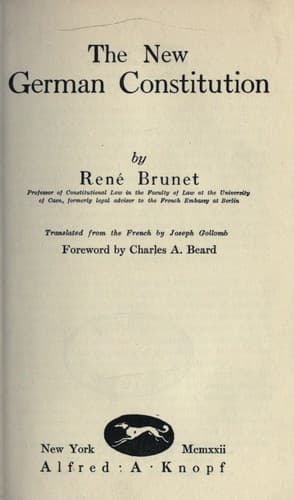
Germany -- Politics and government -- 1918-1933; Germany. Verfassung (1919)
The Council of Commissars of the People thus found itself invested with
political power by the General Assembly of the Councils of Workers
and Soldiers of Berlin. Making immediate use of its power the Council
of Commissars issued on November 12, 1918, a proclamation which
constituted a declaration of rights of the new régime: The state of
siege was revoked. Freedom of assembly and meeting were restored without
restriction. All political offences were amnestied. The eight-hour day
went into effect on January 1, 1919. All elections thereafter would
be held on the basis of equal, direct, universal suffrage based on
proportional representation for all men and women who had passed the
twentieth birthday, etc.
* * * * *
But difficulties arose soon between The Council of Commissars of the
People and the Executive Committee of the Workers and Soldiers Councils
of Berlin. Each of these two bodies considered itself the chief holder
of sovereignty and launched proclamations issuing orders. It became
absolutely necessary to put precise limits to their respective powers.
That was the object of an agreement reached by these two bodies November
22, 1918.
According to the terms of this agreement sovereignty belonged wholly
to the Executive Committee. The Council of Commissars was to exercise
executive power under the permanent control of the Executive Committee.
The latter had the power to nominate or recall members of the Council
of Commissars. In reality the situation was somewhat different; for
the Council of Commissars exercised to some extent legislative powers
according to which it claimed the right to issue decrees that had the
force of laws.
For a month the two bodies worked in this accord. Collisions occurred,
of course. The functionaries of the old régime endured impatiently the
supervision of the Councils of Workers and Soldiers. Inflaming rumours
circulated of the extravagance with which these Councils managed the
public finances. Worst of all was the increasing opposition that
developed all over the country to the Executive Committee of Workers
and Soldiers Councils, which, consisting exclusively of Berlin members,
claimed to represent the Councils of all Germany and which acted in
effect as though it were delegated by the Councils of the whole country.
The fact that on November 23 this Executive Committee had added to itself
a certain number of delegates of Workers and Soldiers Councils of states
other than Prussia, delegates who had authority to deliberate in matters
that concerned all of Germany, did not strengthen the position of the
Executive Committee. Meanwhile, however, its machinery appeared to be
functioning.
* * * * *
Public-domain text, read in full here on John Shaqi.
Reviews
Reviews
No reviews yet
Be the first to share your thoughts on this work.
Join the Discussion
Join the discussion
Sign in to leave a comment or review.
Sign InorCreate an account