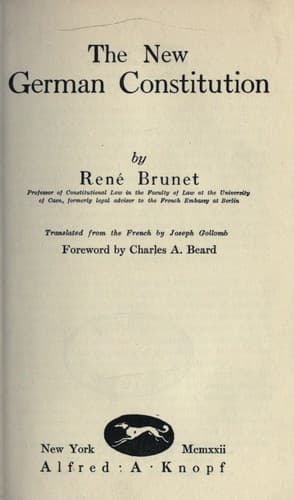
Germany -- Politics and government -- 1918-1933; Germany. Verfassung (1919)
In its largest sense the expression “collective economy” may be defined
as an organization, following a certain predetermined plan, of the
economic system of a country for the purpose, on the one hand, of
obtaining as large an increase as possible in production by the union of
all forces affecting economy; and, on the other hand, for the purpose
of devoting a proper part of the product to the community or to its
productive members.[68] Thus a system of collective economy is any
system that increases public influence in private enterprise, on the
condition that it results in a more just administration and distribution,
particularly in the cases of monopolized industries already organized
into trusts or cartels.
In practice, the principle of collective economy may be applied under
three different forms:
(1) The State may take over immediately and entirely the ownership of the
industries it wishes to subject to the new régime, and direct by itself
and alone, with the aid of its civil servants, the industries which it
has seized. _This is complete socialization._
(2) The State may content itself with participating in the ownership
of certain private enterprises. It owns, for example, a certain number
of shares in a corporation. In such a case, it does not manage the
enterprise wholly, but it has the right of codecision in the general
direction of affairs. _This is partial socialization._
(3) Finally, the State may leave in the hands of individuals the
ownership of enterprises which it wishes to subject to the principles
of collective economy; but it unites, if necessary by constraint, all
those that belong in one industry or in the same category of industries,
such as chemistry, coal, metallurgy, etc. Thus united the enterprises
are administered by means of organs in which are represented all the
categories of the population interested in it, such as owners, workers,
trade unionists, consumers, etc. These organs must be guided, in the
direction they give to this management, above all by a concern for the
general interests of the commonwealth. This is _collective economy_
properly so-called or _nationalization_.
This last form of collective economy is particularly interesting, be it
said. For, on the one hand, it avoids the just criticisms of bureaucracy
and exaction generally directed against socialism properly so-called.
On the other hand, it takes into account the principal demands of the
working class at the present time in recognizing for the workers the
right to participate in the direction of business enterprises.[69]
Public-domain text, read in full here on John Shaqi.
Reviews
Reviews
No reviews yet
Be the first to share your thoughts on this work.
Elsewhere in the archive
Join the Discussion
Join the discussion
Sign in to leave a comment or review.
Sign InorCreate an account