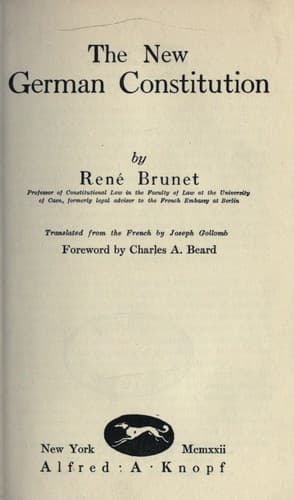
Germany -- Politics and government -- 1918-1933; Germany. Verfassung (1919)
The Constitution does not clearly choose between these three different
methods of applying the principles of collective economy in the large
sense of the word. It declares all three possible and leaves to the
ordinary legislature, whenever it is desirable to regulate an industry
in the general interest, the task of choosing the bearing it wishes to
give such regulations and the régime to which it wishes to subject the
industry in question.
(1) In effect, according to the terms of Article 156 of the Constitution,
the Reich may transfer private business enterprises to public ownership,
that is to say, take over the property for the Reich, the States, or for
the municipalities.
(2) The Reich may participate itself or have the States or the
municipalities participate in the administration of these enterprises, or
may secure for itself in some other manner a decisive influence in these
enterprises.
(3) Or, finally, without taking to itself all or part of these
enterprises the Reich may regulate, on the basis of autonomy and
according to the principles of collective economy, the production and the
distribution of wealth.
In this last case the Constitution specifies that the business
enterprises which are made subject to a nationalization measure, shall
form “an autonomous body” (Selbstverwaltungskörper). This is a new form
in public law. The “autonomous body” is somewhat analogous to ordinary
public corporations. It administers itself with the organs necessary
for it. It enjoys great independence, but it is nevertheless subject
to supervision by the State. Article 156, par. 2, of the Constitution
specifies that when legislation subjects a given industry to the system
of nationalization and organizes the autonomous body it must constitute
the administrative organs of this body in such a way that there shall be
insured the co-operation of all the producing elements of the people, and
that the salaried employés and wage-earners participate in administration
and that the production and distribution satisfy first of all the
interests of the commonwealth.
Public-domain text, read in full here on John Shaqi.
Reviews
Reviews
No reviews yet
Be the first to share your thoughts on this work.
Elsewhere in the archive
Join the Discussion
Join the discussion
Sign in to leave a comment or review.
Sign InorCreate an account