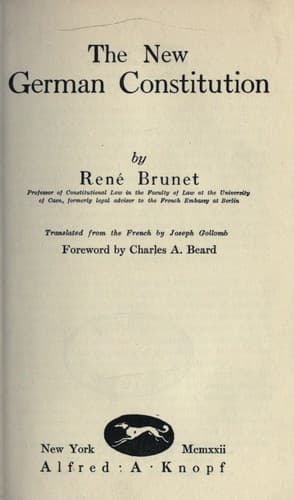
Germany -- Politics and government -- 1918-1933; Germany. Verfassung (1919)
These organs form the Industrial Economic Councils which we have already
examined. An example will illustrate this hypothesis. Legislature
decides, for instance, to subject the chemical industry to the régime of
the collective economy. It combines, therefore, all the manufactories of
chemical products into a sort of obligatory _cartel_, the bond uniting
the different manufactories being more or less close according to
circumstances. The system of administration by “autonomous bodies” will
consist of the institution of one or more organisms, such as Economic
Councils of the Chemical Industry, in which will be represented all the
individuals, associations and Councils interested, and which will manage
together the German chemical industry. The chemical industry will thus
form an autonomous body, that is to say, a sort of public corporation
under the supervision of the State. Further than this, however, it is
not possible at the present time to specify the distinctive traits of
this new legal category. We must wait until legislation has organized a
number of autonomous bodies before we can state precisely their general
characteristics and give them a place in the collective institutions
of public law. Still less possible, naturally, is it to forecast the
economic consequences to which they may give rise.
* * * * *
However, the Constitution has not felt that it should give the ordinary
legislator absolute freedom to proceed according to his fancy to the
enactment of measures for socialization more or less complete. It has
therefore provided certain limits on the exercise of the rights it
confers on the legislature.
(1) Only the legislature of the Reich may enact socialization measures.
(2) No industry may be socialized except when it is “ripe for this
socialization.” This is the so-called _maturity clause_.
(3) Enterprises which the legislator wishes to organize as “autonomous
bodies” may not be so proceeded against except “in case of urgent
necessity.”
These last two restrictions may seem very important. In reality, however,
they constitute a purely fictitious restraint; for the legislature is the
sole judge, at any time that it wishes to socialize an industry, as to
whether that industry is “ripe” or not, and whether or not the case is
one of urgent necessity.
Public-domain text, read in full here on John Shaqi.
Reviews
Reviews
No reviews yet
Be the first to share your thoughts on this work.
Elsewhere in the archive
Join the Discussion
Join the discussion
Sign in to leave a comment or review.
Sign InorCreate an account