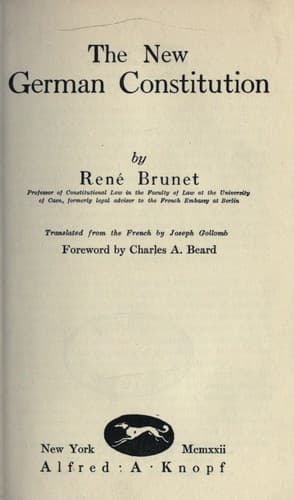
Germany -- Politics and government -- 1918-1933; Germany. Verfassung (1919)
(4) There remains finally the question of indemnity. As may well be
imagined, during the discussion of the project of the socialization law
as well as during the deliberations on the project of the Constitution,
this question was very vigorously discussed. The Socialist parties wanted
no allusion made to this question in the text of the law or that of the
Constitution. The bourgeois parties demanded that at least in the case
of complete socialization the state should be absolutely obliged to
accord an indemnity. It was impossible to arrive at agreement. So that
although the principle of indemnity was incorporated, it was left to the
legislature, whenever it enacts a special law decreeing a socialization
measure, to decide whether or not indemnity shall be accorded and to what
extent.
* * * * *
In accordance with the above provisions a certain number of industries
have been placed under the régime of collective ownership, where they are
about to be transformed.
For the coal, potash and iron industries the laws of March 23, of April
29, 1919, and the regulation of April 1, 1920, have chosen the system of
collective ownership, properly so-called. That is to say, the industries
of coal, potash and metallurgy, although to a very limited extent, have
been organized into autonomous bodies, self-administering under the
supervision of the Reich.
As to electricity, the law of December 31, 1919, provides that electrical
plants that have acquired a certain importance will become the property
of the Reich, the latter, however, providing a suitable indemnity.
The project of the law relative to municipalization, finally, provides
that municipalities may, with the authorization of the Reich,
transfer to the régime of collective ownership private industries
that serve principally common local needs. Full authority is given
the municipalities over all that concerns transportation, water, gas,
cinematographs, theatres, burial, baths, etc. These enterprises may be
either taken over entirely as the property of the municipalities, or
be organized into autonomous bodies. In principle the municipality is
required to indemnify in all such cases.
It is impossible to examine here in full detail these or later laws. It
is interesting, however, to devote several pages in describing in a very
general way, in view of the great importance of the coal industry at the
present time, the system into which it has been transformed.
3.--THE REGULATION OF THE COAL INDUSTRY.
Public-domain text, read in full here on John Shaqi.
Reviews
Reviews
No reviews yet
Be the first to share your thoughts on this work.
Elsewhere in the archive
Join the Discussion
Join the discussion
Sign in to leave a comment or review.
Sign InorCreate an account