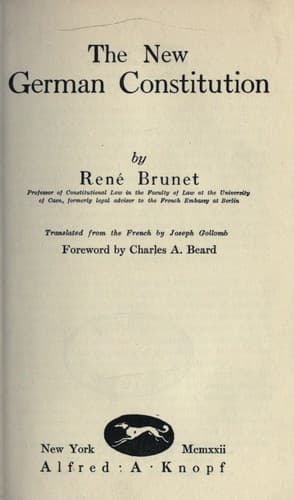
Germany -- Politics and government -- 1918-1933; Germany. Verfassung (1919)
In its final draft the Constitution of 1919 bears throughout the stamp of
_compromises_, which had to be effected between the parties represented
in the Assembly, on practically every problem attacked. On nearly every
question which the Constituent Assembly had to solve, bargains were
negotiated between the conflicting interests and theories of the parties
opposed. If one takes these articles of the Constitution one after
another, one can draw up the balance sheet of every party, and note
the points on which it has won its cause and those on which it had to
compromise. The Social Democrats wanted to substitute for the federal
Empire a unitary State; whereas the Centre, whose co-operation was needed
for the Social Democrats to remain in power, defended the federalist
idea. The final result constitutes a marked victory for the Social
Democrats. But on the question of the relation of Church and State, the
Centre obtained a solution that is much nearer their desires than those
of the Social Democrats. Sometimes problems of a non-constitutional
nature were mixed into negotiations on the Constitution. It is known, for
example, that the Social Democrats secured the signature of the Centre to
the Treaty of Versailles only in exchange for Social Democratic consent
to the compromise clauses on education.
Nevertheless the product of these negotiations and these transactions
constitutes a work whose essential characteristics are clearly enough
indicated, and whose bold outline seems to respond to the demands which
all constitutions of this kind make.
From the point of view of legal technique the Constitution of Weimar is,
on the whole, well made. Conscientiously, scientifically, the men who
drew it up studied foreign Constitutions, subjected them to the most
stringent criticism, tested them by the particular exigencies of the
Reich and by the special character of its people. Here they imitated,
there they initiated. Naturally, they were not wholly able to detach
themselves from the judgments, preferences and prejudices that prevail
in their country. Perhaps from the strictly German point of view it is
better that it should be so. The work is strongly marked with their
traits. It is logical and fine-spun, audacious, complicated and sometimes
obscure, painstakingly conceived and solidly constructed.
But whatever technical merit a legal document may present, it is worth
little unless it accommodates itself to the realities for which it is
created, unless, too, it is strong enough to resist the thrusts directed
against it and to master them. Has the Constitution of Weimar resistance
enough to withstand all the inevitable assaults which will be aimed at
it, and can it guarantee to the German people a well-ordered public life
and a stable government?
Public-domain text, read in full here on John Shaqi.
Reviews
Reviews
No reviews yet
Be the first to share your thoughts on this work.
Elsewhere in the archive
Join the Discussion
Join the discussion
Sign in to leave a comment or review.
Sign InorCreate an account