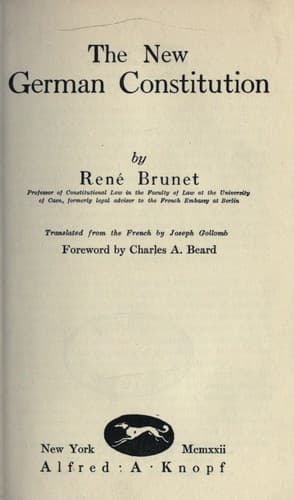
Germany -- Politics and government -- 1918-1933; Germany. Verfassung (1919)
5. Poor relief and vagrancy;
6. The press, associations and public meetings;
7. Problems of population; protection of maternity, infancy, childhood
and adolescence;
8. Public health, veterinary practice, protection of plants from disease
and pests;
9. The rights of labour, social insurance, the protection of wage-earners
and other employés, and employment bureaus;
10. The establishment of national organizations for vocational
representation;
11. Provision for war-veterans and their surviving dependents;
12. The law of expropriation;
13. The socialization of natural resources and business enterprises, as
well as the production, fabrication, distribution, and price-fixing of
economic goods for the use of the community;
14. Trade, weights and measures, the issue of paper money, banking, and
stock and produce exchanges;
15. Commerce in foodstuffs and in other necessaries of daily life, and in
luxuries;
16. Industry and mining;
17. Insurance;
18. Ocean navigation, and deep-sea and coast fisheries;
19. Railroads, internal navigation, communication by power-driven
vehicles on land, on sea, and in the air; the construction of highways,
in so far as pertains to general intercommunication and the national
defence;
20. Theatres and cinematographs.
ARTICLE 8
The Commonwealth also has jurisdiction over taxation and other sources
of income, in so far as they may be claimed in whole or in part for its
purposes. If the Commonwealth claims any source of revenue which formerly
belonged to the States, it must have consideration for the financial
requirements of the States.
ARTICLE 9
Whenever it is necessary to establish uniform rules, the Commonwealth has
jurisdiction over:
1. The promotion of social welfare;
2. The protection of public order and safety.
ARTICLE 10
The Commonwealth may prescribe by law fundamental principles concerning:
1. The rights and duties of religious associations;
2. Education, including higher education and libraries for scientific use;
3. The law of officers of all public bodies;
4. The land law, the distribution of land, settlements and homesteads,
restrictions on landed property, housing, and the distribution of
population;
5. Disposal of the dead.
ARTICLE 11
The Commonwealth may prescribe by law fundamental principles concerning
the validity and mode of collection of State taxes, in order to prevent:
1. Injury to the revenues or to the trade relations of the Commonwealth;
2. Double taxation;
3. The imposition of excessive burdens, or burdens in restraint of trade
on the use of the means and agencies of public communication;
4. Tax discriminations against the products of other States in favour of
domestic products in interstate and local commerce; or
5. Export bounties;
or in order to protect important social interests.
ARTICLE 12
Public-domain text, read in full here on John Shaqi.
Reviews
Reviews
No reviews yet
Be the first to share your thoughts on this work.
Elsewhere in the archive
Join the Discussion
Join the discussion
Sign in to leave a comment or review.
Sign InorCreate an account