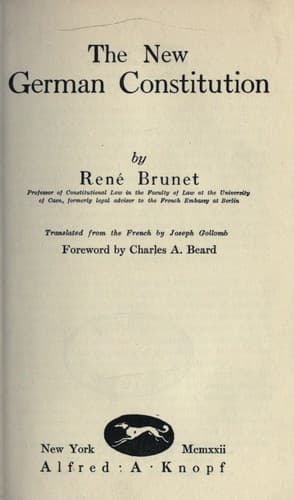
Germany -- Politics and government -- 1918-1933; Germany. Verfassung (1919)
So long and in so far as the Commonwealth does not exercise its
jurisdiction, such jurisdiction remains with the States. This does not
apply in cases where the Commonwealth possesses exclusive jurisdiction.
The National Cabinet may object to State laws relating to the subjects of
Article 7, Number 13, whenever the general welfare of the Commonwealth is
affected thereby.
ARTICLE 13
The laws of the Commonwealth are supreme over the laws of the States
which conflict with them.
If doubt arises, or difference of opinion, whether State legislation is
in harmony with the law of the Commonwealth, the proper authorities of
the Commonwealth or the central authorities of the States, in accordance
with more specific provisions of a national law, may have recourse to the
decision of a supreme judicial court of the Commonwealth.
ARTICLE 14
The laws of the Commonwealth will be executed by the State authorities,
unless otherwise provided by national law.
ARTICLE 15
The National Cabinet supervises the conduct of affairs over which the
Commonwealth has jurisdiction.
In so far as the laws of the Commonwealth are to be carried into effect
by the State authorities, the National Cabinet may issue general
instructions. It has the power to send commissioners to the central
authorities of the States, and, with their consent, to the subordinate
State authorities, in order to supervise the execution of national laws.
It is the duty of the State Cabinets, at the request of the National
Cabinet, to correct any defects in the execution of the national laws.
In case of dispute, either the National Cabinet or that of the State
may have recourse to the decision of the Supreme Judicial Court, unless
another court is prescribed by national law.
ARTICLE 16
The officers directly charged with the administration of national
affairs in any State shall, as a rule, be citizens of that State. The
officers, employés and workmen of the national administration shall, if
they so desire, be employed in the districts where they reside as far
as is possible and not inconsistent with their training and with the
requirements of the service.
ARTICLE 17
Every State must have a republican constitution. The representatives of
the People must be elected by the universal, equal, direct and secret
suffrage of all German citizens, both men and women, according to the
principles of proportional representation. The State Cabinet shall
require the confidence of the representatives of the People.
The principles in accordance with which the representatives of the
People are chosen apply also to municipal elections; but by State law
a residence qualification not exceeding one year of residence in the
municipality may be imposed in such elections.
ARTICLE 18
Public-domain text, read in full here on John Shaqi.
Reviews
Reviews
No reviews yet
Be the first to share your thoughts on this work.
Elsewhere in the archive
Join the Discussion
Join the discussion
Sign in to leave a comment or review.
Sign InorCreate an account