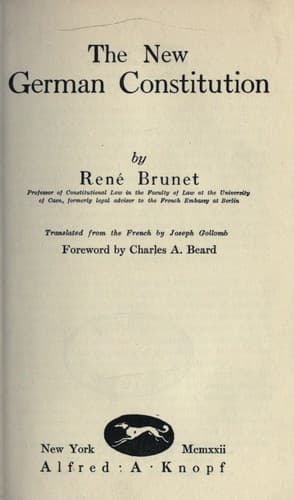
Germany -- Politics and government -- 1918-1933; Germany. Verfassung (1919)
The division of the Commonwealth into States shall serve the highest
economic and cultural interests of the People after most thorough
consideration of the wishes of the population affected. State boundaries
may be altered and new States may be created within the Commonwealth by
the process of constitutional amendment.
With the consent of the States directly affected, it requires only an
ordinary law of the Commonwealth.
An ordinary law of the Commonwealth will also suffice, if one of the
States affected does not consent, provided that the change of boundaries
or the creation of a new State is desired by the population concerned and
is also required by a preponderant national interest.
The wishes of the population shall be ascertained by a referendum. The
National Cabinet orders a referendum on demand of one-third of the
inhabitants qualified to vote for the National Assembly in the territory
to be cut off.
Three-fifths of the votes cast, but at least a majority of the qualified
voters, are required for the alteration of a boundary or the creation
of a new State. Even if a separation of only a part of a Prussian
administrative district, a Bavarian circle, or, in other States, a
corresponding administrative district, is involved, the wishes of the
population of the whole district must be ascertained. If there is no
physical contact between the territory to be cut off and the rest of the
district, the wishes of the population of the district to be cut off may
be pronounced conclusive by a special law of the Commonwealth.
After the consent of the population has been ascertained the National
Cabinet shall introduce into the National Assembly a bill suitable for
enactment.
If any controversy arises over the division of property in connection
with such a union or separation, it will be determined upon complaint of
either party by the Supreme Judicial Court of the German Commonwealth.
ARTICLE 19
If controversies concerning the Constitution arise within a State in
which there is no court competent to dispose of them, or if controversies
of a public nature arise between different States or between a State and
the Commonwealth, they will be determined upon complaint of one of the
parties by the Supreme Judicial Court of the German Commonwealth, unless
another judicial court of the Commonwealth is competent.
The President of the Commonwealth executes judgments of the Supreme
Judicial Court.
_SECTION II_
THE NATIONAL ASSEMBLY
ARTICLE 20
The National Assembly is composed of the delegates of the German People.
ARTICLE 21
The delegates are representatives of the whole People. They are subject
only to their own consciences and are not bound by any instructions.
ARTICLE 22
The delegates are elected by universal, equal, direct and secret suffrage
by all men and women over twenty years of age, in accordance with the
principles of proportional representation. The day for elections must be
a Sunday or a public holiday.
Public-domain text, read in full here on John Shaqi.
Reviews
Reviews
No reviews yet
Be the first to share your thoughts on this work.
Elsewhere in the archive
Join the Discussion
Join the discussion
Sign in to leave a comment or review.
Sign InorCreate an account