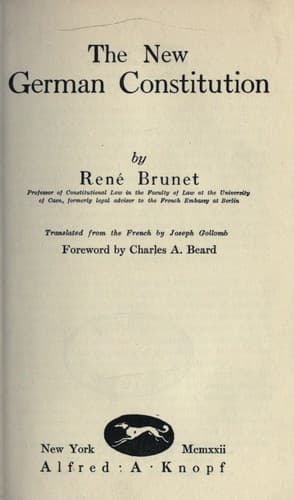
Germany -- Politics and government -- 1918-1933; Germany. Verfassung (1919)
The States will be represented in the National Council by members of
their Cabinets. Half of the Prussian votes, however, will be at the
disposal of the Prussian provincial administrations in accordance with a
State law.
The States have the right to send as many representatives to the National
Council as they have votes.
ARTICLE 64
The National Cabinet must summon the National Council on demand by
one-third of its members.
ARTICLE 65
The chairmanship of the National Council and of its committees is filled
by a member of the National Cabinet. The members of the National Cabinet
have the right and on request [of the National Council] the duty to take
part in the proceedings of the National Council and its committees. They
must at their request be heard at any time during its deliberations.
ARTICLE 66
The National Cabinet, as well as every member of the National Council, is
entitled to make proposals in the National Council.
The National Council regulates its order of business through rules of
procedure.
The plenary sittings of the National Council are public. In accordance
with the rules of procedure the public may be excluded during the
discussion of particular subjects.
Decisions are taken by a majority of those present.
ARTICLE 67
The National Council shall be kept informed by the National Departments
of the conduct of national business. At deliberations on important
subjects the appropriate committees of the National Council shall be
summoned by the National Departments.
_SECTION V_
NATIONAL LEGISLATION
ARTICLE 68
Bills are introduced by the National Cabinet or by members of the
National Assembly.
National laws are enacted by the National Assembly.
ARTICLE 69
The introduction of bills by the National Cabinet requires the
concurrence of the National Council. If an agreement between the National
Cabinet and the National Council is not reached, the National Cabinet
may nevertheless introduce the bill, but must state the dissent of the
National Council.
If the National Council resolves upon a bill to which the National
Cabinet does not assent, the latter must introduce the bill in the
National Assembly together with a statement of its attitude.
ARTICLE 70
The National President shall compile the laws which have been
constitutionally enacted and within one month publish them in the
National Bulletin of Laws.
ARTICLE 71
National laws go into effect, unless otherwise specified, on the
fourteenth day following the date of their publication in the National
Bulletin of Laws at the national capital.
ARTICLE 72
The promulgation of a national law may be deferred for two months, if
one-third of the National Assembly so demands. Laws which the National
Assembly and the National Council declare to be urgent may be promulgated
by the National President regardless of this demand.
ARTICLE 73
Public-domain text, read in full here on John Shaqi.
Reviews
Reviews
No reviews yet
Be the first to share your thoughts on this work.
Elsewhere in the archive
Join the Discussion
Join the discussion
Sign in to leave a comment or review.
Sign InorCreate an account