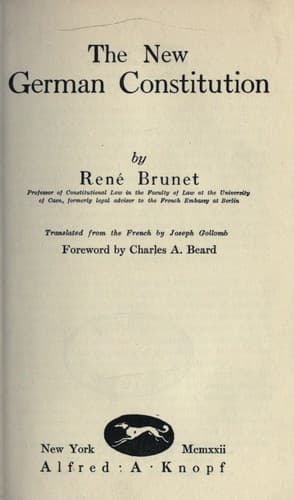
Germany -- Politics and government -- 1918-1933; Germany. Verfassung (1919)
These two fundamental objectives were self-explanatory and mutually
compulsory. For, given the disproportion in power that existed between
Prussia and the other states, the more one increased the power of the
Reich to the detriment of the states the more one strengthened the
domination of Prussia, for thereby Prussia was made all powerful within
the Reich. If, therefore, the centralizing character of the Constitution
was to be accentuated, the following dilemma would have to be confronted.
Either Prussia as it was would have to be accepted by the Reich, in
which case the German Republic would in reality become a unitary
Prussian Republic in which non-Prussian parties would be subjected to
the will of Prussia. Or, if this state of affairs was to be avoided and
a unitary state with central will was desired, Prussia would have to be
suppressed, either by a partition of her own accord or one imposed upon
it by the Reich.[11] It was this latter alternative that Under-Secretary
of State Preuss chose when he was put in charge of the drafting of the
Constitution.
The individual states, he pointed out, were the products of purely
dynastic politics which almost everywhere ran counter to the natural
relations of populations and races, separating what should have been
united and uniting elements that had nothing in common. Only the republic
has the possibility--it is also its duty--to reunite what belonged
together. The fundamental question of the internal organization of
Germany is, can a centralized Prussian State be maintained within the
future German Republic? This question Preuss, after philosophical,
historical considerations, answered in the negative. He demanded the
territorial redistribution of the states on the basis of the right of
populations to self-determination, according to their needs and their
political and economic inclinations, with the intervention, by the
sanction and under the direction of the Reich. Preuss insisted throughout
on the fact that Prussia is not a nation, but that she constitutes an
artificial formation, due to the political hazards of a reigning house,
purchases, marriages, conquests, etc. The Prussian state does not form
an organic whole and is bound together neither by economic nor cultural
relations. It is an incomplete German state, “an edifice of fortune.”
Even admitting that it had been for a time indispensable, in that it
constituted to a certain measure an internal bond, it has now outlived
its usefulness as a state. The national unity of Germany as a whole is
a vital question for the German people and therefore for the German
Republic. It is imperative that the diverse races who lived in forced
unity in Prussia should be at once placed under the sovereignty of the
Reich instead of being “mediatized” by a state that interposes itself
between them and the Reich. It is only by the suppression of Prussia
that these populations can secure that equality which is their right by
the side of the other German states.
Public-domain text, read in full here on John Shaqi.
Reviews
Reviews
No reviews yet
Be the first to share your thoughts on this work.
Join the Discussion
Join the discussion
Sign in to leave a comment or review.
Sign InorCreate an account