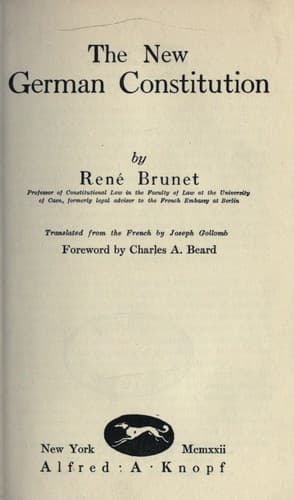
Germany -- Politics and government -- 1918-1933; Germany. Verfassung (1919)
Territory is one of the essential elements of a state. In a confederated
state the central government cannot force on the member states changes
or exchanges of territory, fusions or parceling of their respective
holdings. Such was in principle the régime prevailing in the old German
Empire. The historic composition of the individual states as they were
when their princes signed the federal pact in 1871 was guaranteed, and
the territories of individual states were protected by the Constitution
in the geographic integrity they had when they entered the Empire.
The Constitution of Weimar on the other hand put forward the principle
_of the mobility of frontiers_. But it was not until after the most
violent and passionate discussions that this was adopted, and not without
modifications that peculiarly limited its operation. For, what was
foremost in the deliberations and constantly dominated them was neither
more nor less than the question of the dismemberment of Prussia. The
cardinal consideration was this: legally the majority of the problems of
organization that the Constitution had to solve would depend for their
solution according to whether Prussia would or would not retain its
territorial integrity. But the political problem was also grave. Prussia
remaining as such, would it not exercise again its former hegemony over
Germany with all the attendant dangers to the domestic and foreign
policies of the Reich, dangers of an obstinate reaction at home and of an
insatiable pan-Germanism abroad?
1.--THE PROBLEM OF THE DISMEMBERMENT OF PRUSSIA.
In November, 1918, there was felt throughout Germany a very powerful
centrifugal movement. The masses of the people saw in the Reich nothing
more than an alliance of princes and Prussian domination. It was to
the princes and to Prussia that they attributed the inexpiable fault
of having begun the war and lost it. During several weeks of limitless
despair, two cries were raised, “Down with the Princes!” and above that,
“Separation from Prussia!” It must be added that behind these cries was
partly the unavowed hope that by abandoning the Reich one could more or
less escape the menacing consequences of defeat. The Reich seemed on the
point of dissolution.[10]
But some men at once realized that if Germany was to be saved the one
efficacious remedy was to revive in the people the sentiment of national
unity and to reconstruct the Reich on new bases. A unitary republic would
have to be created and the domination of Prussia overturned.
Public-domain text, read in full here on John Shaqi.
Reviews
Reviews
No reviews yet
Be the first to share your thoughts on this work.
Join the Discussion
Join the discussion
Sign in to leave a comment or review.
Sign InorCreate an account