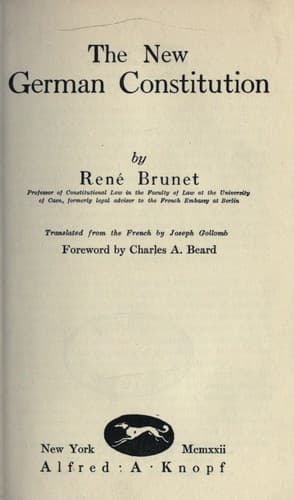
Germany -- Politics and government -- 1918-1933; Germany. Verfassung (1919)
Firstly, they insisted, Prussia is no longer what it was before the
Revolution. Formerly it was a powerful state enjoying all the advantages
of hegemony and all the privileges which came from the fact that the
German Emperor was the King of Prussia. To-day, said they, Prussia, whose
military backbone is broken, finds itself economically and financially
ruined and all its ancient prerogatives taken away. Furthermore, its
former electoral system based on a class suffrage is gone and all the
elements, including those of the Rhine, can make themselves equally felt
thereafter.
Prussia as it now exists should be maintained, they went on. Its
dismemberment would hurt the Reich more than it would serve it. Only
powerful states, in command of important financial resources, can
discharge the innumerable duties that to-day are incumbent on public
organisms. Not only is Prussian culture necessary for the development of
German culture, but the downfall of Prussia would involve the downfall
of Germany; for Prussia is the cement that holds together the unity of
the Reich, and renders services proportional to its greatness. Then,
too, what would be the result of a dismemberment of Prussia? Aside
from the fact that the advocates of dismemberment are absolutely unable
to indicate the number and extent of the states into which they would
carve Prussia, its parcelling out would involve a considerable loss in
power and spirit, in time and in money. For each new state will want to
have new administrative apparatus complete in every respect, a separate
constitution, a separate parliament, a separate legislature, and so on.
These states by reason of their weakness will be unable to discharge the
obligations that would fall upon them. Still further, nothing was more
illogical than to create new states if one wants to realize some day or
other the unity of the Reich; for, each of these states will constitute
later on just one more obstacle to such a unity.
Finally, said the Prussians, Prussia, which has already given all and
sacrificed all to the greatness of the Empire, is ready to renounce
still more, for the benefit of the Reich, what still remains of its
independence, provided, _that the other states do as much_.
But it was precisely this demand that made the proposition impossible of
acceptance by the others. In “sacrificing to the Reich all that remained”
of the ancient rights of Prussia, the latter in reality sacrificed
nothing; on the contrary, it gained a great deal. For, mistress of the
Reich as it would be, it would secure thereby not only everything it
brought to it, but also all that the other states contributed to it. It
was thus, therefore, that Preuss always came back to the same dilemma:
either a Germany under Prussian hegemony or a Prussia dissolved into the
Reich.
Public-domain text, read in full here on John Shaqi.
Reviews
Reviews
No reviews yet
Be the first to share your thoughts on this work.
Join the Discussion
Join the discussion
Sign in to leave a comment or review.
Sign InorCreate an account