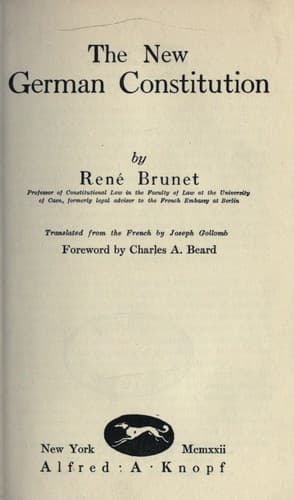
Germany -- Politics and government -- 1918-1933; Germany. Verfassung (1919)
The debate came back again and again to this version; and when the
question reached the second reading before the National Assembly there
was presented an amendment drawn up by Löbe of the Social Democrats,
Trimborn of the Centre, and Heile of the Democrats, which after very much
discussion among the government and the representatives of the states
modified considerably the version of the Committee on the Constitution.
On the one hand, territorial modifications were facilitated in the sense
that new states could thereafter be created, even against the desires
of the interested states, by a simple law; for they wanted to avoid,
for example, the situation in which Prussia or another state could
completely prevent all territorial modification by rendering impossible
the necessary majority for the vote needed to enact a constitutional law.
On the other hand, the creation of such a new state was rendered more
difficult in the sense that it considerably complicated the conditions
according to which the populations affected could express their desires.
But most important of all--and that was the principal provision of the
amendment--it was specified that no territorial change could be effected
against the wish of the states concerned before a period of two years
after the formal adoption of the Constitution.
Thus Prussia was guaranteed for at least two years against dismemberment.
This last provision was aimed at the Rhineland whose situation, as
it was clearly indicated at the Assembly, was at the bottom of all
the discussion. It was declared that the Rhineland needed above all
tranquillity in the particular circumstances in which it found itself;
that occupied by foreign troops it could decide its territorial needs
only with difficulty; and that, above all, the creation of a state on
the banks of the Rhine would be considered abroad as a preliminary
to the complete independence of this state from the German Reich; and
that it was “necessary to maintain a unity of front against French
imperialism.” Along this line of argument it was further insisted that
the dismemberment of Prussia has been the chief aim of the war waged
by the enemies of Germany and the creation of a Rhenish Republic would
be exploited by them as an additional victory. This resulted in the
deputies from the Rhenish provinces declaring in the tribune of the
Assembly their loyalty to the Reich and that whatever were their desires
to see the Rhineland organized into a state, they would support the
Löbe-Trimborn-Heile amendment including the postponement for two years of
their justifiable claims.
The amendment was adopted by vote of 169 to 71, with 10 abstentions.
Public-domain text, read in full here on John Shaqi.
Reviews
Reviews
No reviews yet
Be the first to share your thoughts on this work.
Join the Discussion
Join the discussion
Sign in to leave a comment or review.
Sign InorCreate an account