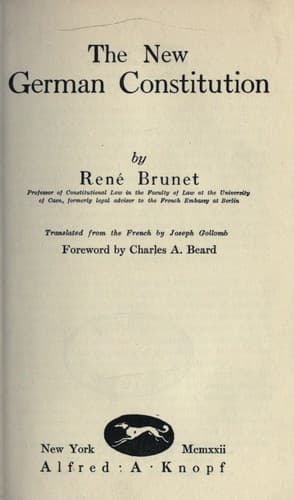
Germany -- Politics and government -- 1918-1933; Germany. Verfassung (1919)
(2) But cases may present themselves in which populations wish to
separate from a state to which they belong, against the desires of the
government of the state. The Constitution provides that the wish of these
populations must be followed. According to Article 18 an ordinary law
is sufficient to permit territorial changes or the creation of states
if the interested states do not consent to it, but _if the wish of the
population demands it and at the same time the preponderant interest of
the Reich requires it_. This provision is evidently directed against
Prussia; for should in such a case a constitutional law be demanded
Prussia would command a sufficient number of votes in the Assemblies to
prevent changes it did not wish. The dismemberment of Prussia is thus
rendered theoretically possible by this provision. But we know that this
provision is not applicable before August 12, 1921.
It remains to be seen how the wish of a population can manifest itself in
the operation of the latter provision.
The population may either be consulted by the government of the Reich,
which can order an immediate plebiscite; or the population can take the
initiative and impose on the government of the Reich the obligation of
ordering the plebiscite. This initiative must be signed by a third of
the inhabitants of the territory whose separation is asked for. The
plebiscite in such a case must be ordered by the government of the Reich.
Whether the plebiscite is ordered by the government or results from
popular initiative, it must, to be effective, satisfy the following
conditions of majority. They must obtain (a) three-fifths of the total
number of votes cast; (b) a majority of the votes of the inhabitants
entitled to suffrage; (c) and finally when the question is one of
dividing a territory which wishes to separate from its state, the
population of the whole district or administrative division of which
it was a part must be consulted; this in order to avoid break-ups due
to parochial quarrels. In other words, the plebiscite must extend to
the whole district even if the part that wishes to separate forms only
a fraction of this district. Nevertheless Article 18 provides for
practical purposes one exception to this third condition. This refers
to exceptional districts, that is to say, sections of territory that
have no geographical kinship with the district to which they belong. In
such a case a special law of the Reich could decide that the wish of the
population of this special district is sufficient and that the entire
population of the district to which it belongs need not be consulted.
The plebiscite having rendered an affirmative verdict the government of
the Reich must submit to the Reichstag the project of law necessary to
effect the changes in territory desired by the population.
Public-domain text, read in full here on John Shaqi.
Reviews
Reviews
No reviews yet
Be the first to share your thoughts on this work.
Join the Discussion
Join the discussion
Sign in to leave a comment or review.
Sign InorCreate an account