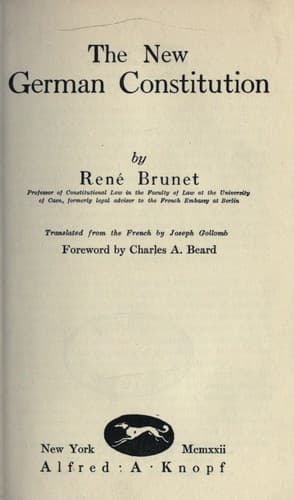
Germany -- Politics and government -- 1918-1933; Germany. Verfassung (1919)
(3) An ordinary law is sufficient _to modify the outer boundaries of the
state_, that is to say, the frontiers of the Reich itself, when these
are necessitated by a treaty of peace. When these modifications are to
be effected otherwise than by the special case of a treaty of peace, the
consent of the state affected must be obtained (Article 78).
Such are the provisions of the Constitution relative to the territorial
status of the states, but it must be recalled that certain of these
provisions--those which aim at territorial change based on the desires
of the population but against the wishes of their state government--do
not become operative until two years after the adoption of the
constitution. Thus up to August 12, 1921, no parcel of the territory of
Prussia, Bavaria, Hesse, Oldenburg, occupied by foreign armies, could be
constitutionally taken away from their states without their wish. The
aim pursued by the constituent Assembly in adopting this provision was
to combat separatist attempts of powers whose armies occupy German soil,
and to avoid all appearances and possibilities of dismemberment until
revolutionary effervescence and political disorders shall have come to
an end.
3.--THE CREATION OF A STATE--THURINGIA.
The provisions which we have elucidated have already been put into
operation. A new state has appeared in the Reich created by the fusion of
several former states.
Almost immediately after the revolution of November, 1918, a project was
born in central Germany to fuse several states there and to form of their
territories the state of “Thuringia.”
First the two states of Reuss reunited. On December 21, 1918, they
organized an administration in common and the fusion became operative on
April 4, 1919. This new state appeared thereafter as a sort of centre for
crystallization. The first state to join this movement was the Republic
of Altenburg, with which Reuss had many interests in common.
But this development toward the federation of states of central Germany
was soon interrupted and seemed for a time even definitely arrested. The
men who were pushing the project of extending this movement conceived
the idea of the creation of a “Great Thuringia,” which would comprise
important parts of Prussian territory and which would have as the
economic and political centre and as capital the Prussian city of Erfurt.
Public-domain text, read in full here on John Shaqi.
Reviews
Reviews
No reviews yet
Be the first to share your thoughts on this work.
Join the Discussion
Join the discussion
Sign in to leave a comment or review.
Sign InorCreate an account