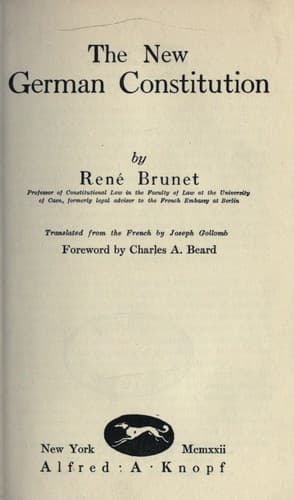
Germany -- Politics and government -- 1918-1933; Germany. Verfassung (1919)
The execution of this plan aroused violent opposition on the part of
the government of Prussia, such as it manifested whenever the question
came up of the separation from it of any part of its territory. It
encountered also the strong objection on the part of the authorities
and the population of Erfurt who preferred the present advantage of
belonging to the most powerful German state rather than the possible
benefit of becoming an important element in a new state. The project of
a “Great Thuringia” was abandoned and the effort continued as before to
form a state which should comprise all the states of Thuringia without
appropriating any Prussian territory.
Of the eight republics of central Germany included in this plan of fusion
one, that of Coburg,[12] refused to join the movement. This republic,
having on October 30 inaugurated a plebiscite to find out whether the
population wished to belong to Bavaria or to the future “Thuringia,”
obtained 3,460 votes for Thuringia and 16,102 votes for Bavaria. This
reunion with Bavaria was then consummated, with the consent of Bavaria,
by a law of the Reich of April 30, 1920.
As for seven other republics--Saxe-Weimar-Eisenach, Saxe-Altenburg,
Reuss, Saxe-Gotha, Schwarzburg-Rudolstadt, Schwarzburg-Sondershausen and
Saxe-Meiningen--they concluded a “treaty” by which they combined in a
“community” to prepare their complete fusion.
To this effect the treaty provided two organs:
(_a_) A popular Council, the legislative organ of the “Community,”
composed of representatives of each of the seven Diets;
(_b_) A Council of States, the executive organ, consisting of
representatives of each of the seven governments.
These organs had as their mission to study and take all preliminary
measures necessary for the fusion. To permit the accomplishment of
this mission the states transferred to them all their legislative and
administrative powers necessary. The laws voted by the popular Council
were therefore compulsory in the territory of all the seven states. They
were particularly operative over the governments and the administrative
authorities of these states.[13]
The common organs were in addition instructed to prepare the Constitution
of their future state.
When all these necessary preliminary provisions had been taken the
Reich declared the fusion in being. All the interested states being in
agreement with this step an ordinary law sufficed; and it carries the
date of April 30, 1920.
SECTION II
THE DIVISION OF POWER BETWEEN THE REICH AND THE STATES
The unitary character of the Constitution appeared not only in the fact
that it recognized in principle the right of the Reich to regulate
the territorial status of the states. It appeared also in the clauses
relating to the division of authority between the Reich and the States,
provisions that took from the latter and gave to the Reich a considerable
quantity of powers of a constitutional character as well as legislative
and administrative.
Public-domain text, read in full here on John Shaqi.
Reviews
Reviews
No reviews yet
Be the first to share your thoughts on this work.
Join the Discussion
Join the discussion
Sign in to leave a comment or review.
Sign InorCreate an account