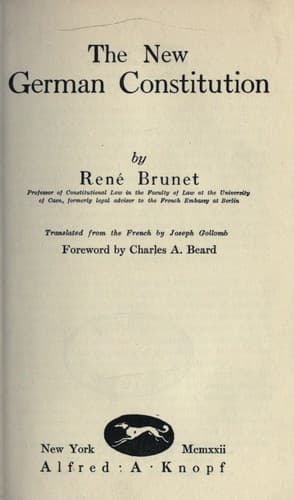
Germany -- Politics and government -- 1918-1933; Germany. Verfassung (1919)
These three principles were accepted without serious difficulty. A
twofold point must, however, be noted. First that all Germans could vote
in all the states for the election of the popular Chamber, that is to
say, for example, a Bavarian could vote at the election of the Prussian
Diet. This provision is one of the principles that suppressed almost
entirely the nationalistic motive of the individual states; it is clearly
characteristic of the unitary tendency of the constitution. In addition
to this, Article 17 adds to the general conditions a special condition
in the case of local elections: a year’s residence in the district is
necessary for the right to vote.
In the National Assembly the speakers for the parties of the Right
insisted at great length on the difference that exists between political
elections and purely local elections. In the latter it was necessary
above all that the elector choose men known to be familiar with local
needs and competent to satisfy them. These propositions are undisputable,
but the conclusion which the German Nationalists drew from them was
that to be an elector in a district one must be a holder of property
in it. These conclusions were rejected by the Assembly as contrary to
the democratic principle, and a year’s residence was the only condition
finally adopted.
2.--THE LEGISLATIVE POWER OF THE REICH.
The states are limited not only in their right to adopt whatever
constitution they desire; they are also limited considerably in
legislative power by that of the Reich.
I.--FUNDAMENTAL LIMITS OF POWER.
Already the Constitution of 1871 had reserved to the Reich a certain
number of matters on which only it had the right to legislate. It was
thus that foreign affairs, citizenship, customs, indirect taxes,
railroads, post and telegraph, legislation, civil, penal and commercial,
the army, the navy, the police and regulation of the press, all were
included in the legislative authority of the Reich. In the memorandum
submitted by Preuss in his draft of the Constitution, he insisted on
the necessity of revising this division of authority. He submitted as a
principle that all state functions belonging naturally to the national
collectivity as such should be concentrated in the hands of the Reich
more strongly, more exclusively and more clearly than in the preceding
constitution. On the other hand, the autonomy and free administration
of the smaller collectivities, from the communes up, would find their
consummation and their most complete development in the republics, which
should be constituted in united groups according to the nature of their
populations and their economic structure.
Public-domain text, read in full here on John Shaqi.
Reviews
Reviews
No reviews yet
Be the first to share your thoughts on this work.
Join the Discussion
Join the discussion
Sign in to leave a comment or review.
Sign InorCreate an account